The Pentagon’s Drone Dominance program is moving at a fast pace — at least rhetorically. In late July, the DDP touted major investment in new American drone-production lines, expansion of existing manufacturing, and “incredible growth” in component and sub-component output. Last week the DDP announced the winners of its second competitive round. But between Gauntlet I and Gauntlet II, the list of companies involved has visibly shifted. Stricter component requirements under the Supply Chain Framework may be one reason. But it’s also worth noting that the White House has developed its own leaderboard of industry leaders — one that doesn’t match the Pentagon’s rankings.
The optimism runs a bit ahead of the facts
Days ago, the Army’s Drone Dominance director, Col. Gregory Merkl, said the program has already put enough drones in the hands of every unit. What’s left, he said, is training soldiers to operate under enemy electronic warfare and building out qualified pilots down to squad level.
Merkl was measuring the program against a specific target. Defense Secretary Pete Hegseth’s original mandate, issued in July 2025, set a clear deadline: every Army squad was to be outfitted with small attack drones by the end of fiscal 2026, September 30.
Thirteen days before that deadline, on September 17, Merkl told reporters the Army had fielded 10,000 small attack drones from across its acquisition channels, with another 30,000 on the way. He said the capability now reaches every platoon — one level above squad, not yet down at squad level itself.
So Merkl’s “mission accomplished” framing looks a bit premature.
Meanwhile, the flagship competition that gave the program its name is still behind on its own, considerably smaller order. Gauntlet I’s official Phase I goal was 30,000 drones. The actual contracts placed after the competition came to 22,320 drones across 11 companies — 24,320 counting a 2,000-drone bonus order added for Neros. That order, smaller than the original target, still isn’t fully delivered.
Where Gauntlet I stands
As of September 22, the Gauntlet I order is roughly 57% complete (measured against the original 22,320 drones) — up from 54% just days earlier, as the Pentagon worked through a backlog of drones that had been sitting in inspection.
Seven of the eleven winners have now fully shipped their batch — Ascent AeroSystems joined that group this week, shipping its remaining 280 units. But only three have fully passed quality control and had their drones accepted: Neros (not counting its bonus order), UDD — Ukrainian Defense Drones, the U.S. company representing F-Drones — and Griffon Aerospace.
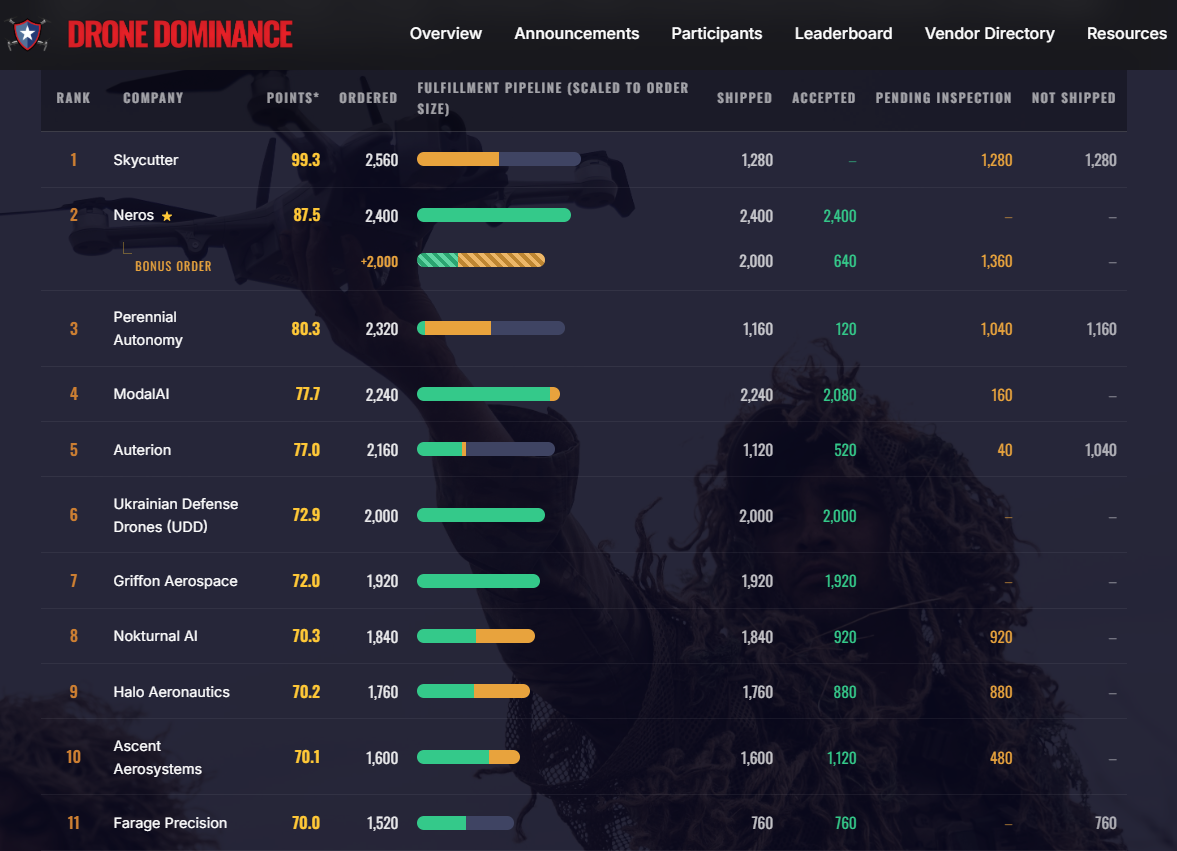
Drone Dominance Gauntlet I leaderboard. Screenshot from 09/22/2026
Gauntlet II: A three times harder task
Under the new rules, the winner in each of the two mission categories — long-range strike, and combat in built-up urban terrain — receives an order for 8,000 drones. That’s roughly three times the typical Gauntlet I order (2,000–2,560 per company). At least two of Gauntlet II’s winners — Skycutter and Perennial Autonomy — still haven’t finished delivering on their Gauntlet I contracts. Now they must fulfill a new order, three times larger, in parallel.
New names have appeared among the winners, and some familiar ones have dropped out. Looking at the program’s full history rather than a single round, three companies stand out as consistently strong:
Neros — the clear leader: 2nd place in Gauntlet I, then wins in both Gauntlet II categories at once.
Perennial Autonomy — the second consistently strong player, though it entered the competition under a different name (Napatree, in Gauntlet I). It won the long-range strike category.
ModalAI Inc — the third consistently strong player, though this time it qualified in the last available spot.
The White House sees it differently
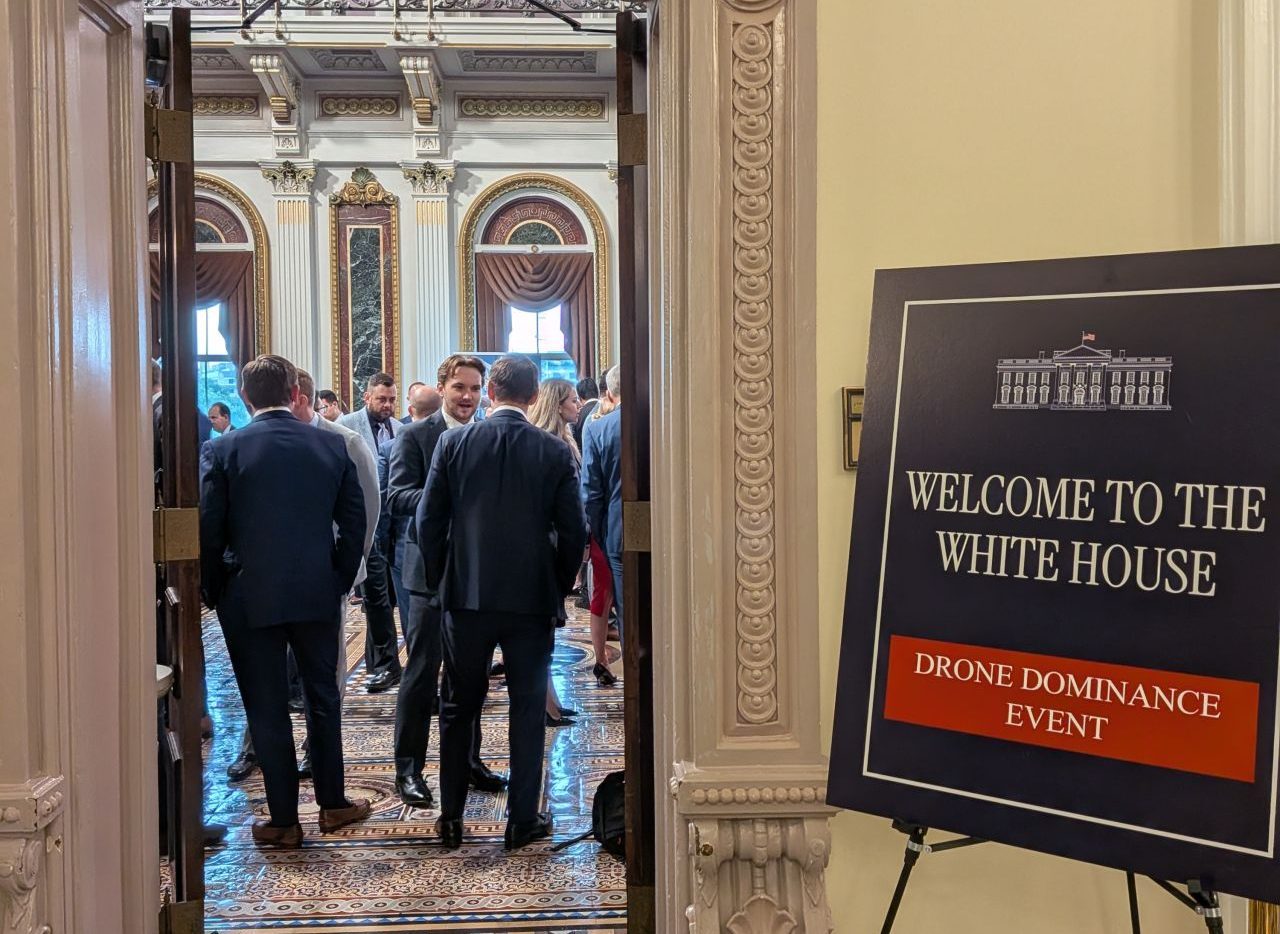
On August 18, before Gauntlet II’s results were announced, the White House held its own event for the drone industry — no longer under the Pentagon’s auspices.
The guest list for the Drone Dominance event at the White House says a lot about how the administration sees the industry’s development. The first thing that stands out: all three drone companies with financial ties to the Trump family made the cut for the roughly 40 invitees.
Unusual Machines Inc. Donald Trump Jr. serves as an adviser to the company. On August 10, 2026, it published an updated investor presentation laying out a strategy aimed at the estimated $3–5 billion U.S. drone-components market.
PowerUS. Backed by investors including both Donald Trump Jr. and Eric Trump, the company did not compete in Gauntlet I at all — it’s a new entrant for Gauntlet II.
XTEND. It competed in Gauntlet I but did not make the top 11. Shortly before the results were officially announced, in February 2026, Eric Trump invested in XTEND’s $1.5 billion merger with JFB Construction Holdings. On August 18, XTEND was among the guests at the White House reception. Gauntlet II’s results weren’t known yet — they weren’t announced until September 16. That’s when it turned out XTEND had placed third in the Tactical Assault in Confined Environments category.
On its own, that isn’t suspicious — the company went through a real competitive selection and delivered a result. The more interesting question is what the White House was going on when it drew up its guest list in the first place. Only two of the eleven Gauntlet I winners — Neros and Perennial Autonomy — were at the reception. Of the other nine, just two — Skycutter and ModalAI — went on to win a Gauntlet II award. The remaining seven, including Farage Precision and Halo Aeronautics, which didn’t even qualify for the Gauntlet II finals, came away with nothing.
The guest list already looks closer to Gauntlet II’s leaderboard. Four of the nine winners — Neros, Perennial Autonomy, XTEND, and Swarm Defense Technologies — had already been in the room. The list’s most notable feature, though, wasn’t any individual company. It was the sheer number of component suppliers — batteries, magnets, motors, chips, cameras. Of the roughly 40 invitees, close to a third fell into that category.
The component Strait of Hormuz
The war in Ukraine calls for the cheapest, most mass-producible solutions — that’s precisely why FPV drones became a mass weapon there in the first place. But the most effective mass-produced systems actually working on the front line today still depend on Chinese components. Overcoming that dependency — not the drone competition itself — is the real point of Drone Dominance.
An analogy to the oil market is useful here. When the Strait of Hormuz — the narrow channel that carries a quarter of the world’s oil supply — comes under threat of closure, markets react with a sharp shock and adapt only slowly, at real cost. Something similar is playing out with the drone component base, just inside a more controlled environment.
On July 23, the DDP released the second version of its Supply Chain Framework. The first version, from late April, had one main rule: motors and batteries had to come from “non-covered” countries — not China, Russia, North Korea, or Iran. The second version lays out 13 component categories across four phases running all the way to August 2027, and adds new categories — ground control stations, microelectronics. Requirements for disclosing the origin of rare-earth materials also keep getting stricter with each phase.
As Drone Dominance plays out, the first companies to scale up production of non-Chinese components made from non-Chinese rare-earth materials won’t just profit from direct Pentagon contracts. They’ll be able to earn money from every Drone Dominance winner at once — because all of them will need to find such components to avoid being disqualified from the program. That’s why the Office of Strategic Capital — a body with over $200 billion in lending authority, two orders of magnitude larger than Drone Dominance’s entire $1.1 billion budget — is so actively financing magnet and battery makers (Sila, Niron Magnetics) rather than companies that merely assemble finished drones.
Real money, real growth
Despite all the difficulties, interest in growing the industry is enormous — and the Trump family’s financial involvement is evidence of that: real money is flowing in, not just political attention. Component requirements will keep getting more complex with every new phase. That means the situation will likely keep getting worse until the industry fully shifts to non-Chinese supply chains. Only then will real adaptation and scaling begin.
For now, the need to adapt to increasingly strict component requirements appears to have pushed some of Phase I’s most effective products out of the race, or made them less competitive. That explains the shifting cast of players. Among the “conditionally Ukrainian” producers, only Skycutter remains among the winners (through its SkyFall partnership). In their place, new players have appeared, some of them deeply obscure: Vector — a Utah startup with almost no public track record; Hyperscale — a company the industry itself describes as “a dark horse still in stealth mode.”
Whether the winners can scale quickly without losing quality, as they’re forced to fit an increasingly narrow component base, remains an open question. The scores themselves are an indirect signal: Gauntlet I winners ranged from 99.3 to 70 points. Gauntlet II’s winners span a narrower range, roughly 88.1 to 66. That could mean competition is intensifying — or that stricter component rules are pulling everyone’s performance down.
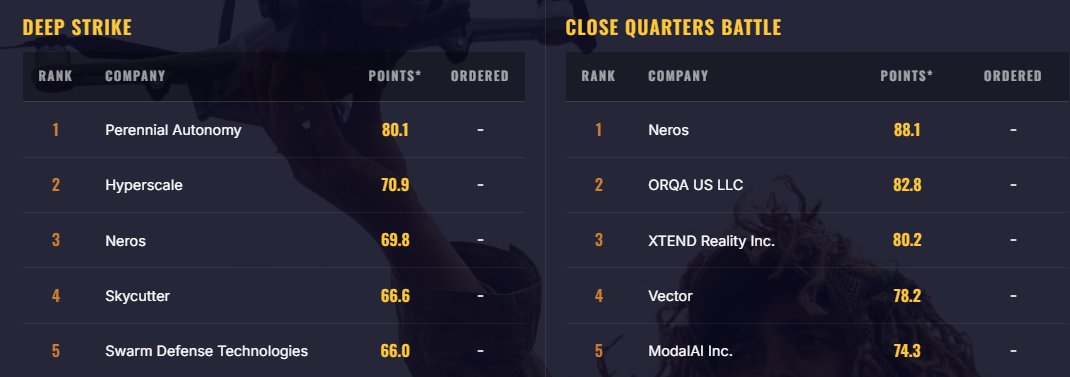
Drone Dominance Gauntlet II leaderboard. Screenshot from 09/22/2026
And even as the program pushes companies to purge Chinese components from their own supply chains, the military’s own testing still leans on them where it’s convenient. On September 21, at Yuma Proving Ground, NORAD and Northern Command ran a counter-drone experiment testing Perennial Autonomy’s Bumblebee interceptors — against aerial targets that included civilian DJI Mavic 3 quadcopters, made in China.