
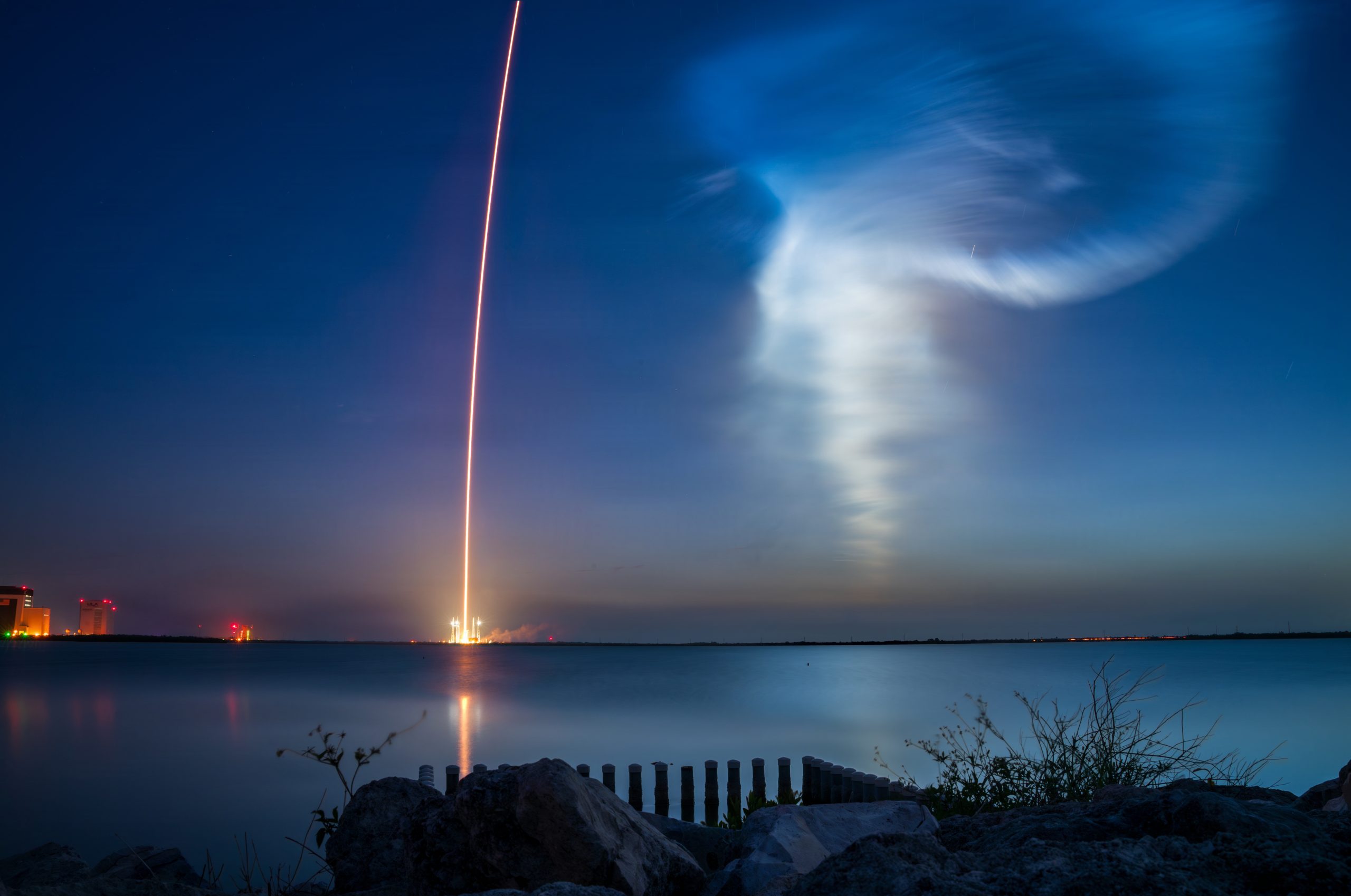
At around 3:40 a.m. local time on August 15, residents of Samara heard the sound of an aircraft-like object overhead, followed by a powerful explosion and a large fire. Within minutes, a missile alert covered the region. By morning, Ukrainian and Russian open-source accounts had converged on the same probable target: RKTs Progress, the plant that builds Russia’s Soyuz-2 family of rockets — the same rockets Russia has used, twice so far, to put its “Rassvet” satellite constellation into orbit. The strike, reportedly carried out with Fire Point’s FP-5 “Flamingo” cruise missiles, is the clearest sign yet that the war over Ukraine’s skies has a second, quieter front roughly five hundred kilometers up. For four years, low-earth-orbit satellite internet has moved from a convenience to a precondition for modern combat — and every major power involved in or watching this war has drawn the same conclusion from it.
From Commercial Broadband to Military Backbone
SpaceX’s Starlink was conceived as a commercial broadband product. But its military value was recognized early: the U.S. Army signed an agreement to test Starlink for unit-to-unit data transmission back in 2020, well before satellite internet became a fixture of front-line reporting. Russia’s full-scale invasion of Ukraine, and the mass adoption of drones that followed, turned that early test into doctrine.
The logic is straightforward. An army that depends on ground towers and buried cable loses communications the moment that infrastructure is destroyed. An army with access to a constellation of thousands of low-orbit satellites keeps talking even when everything on the ground has been leveled. That single fact explains why satellite internet went, in under four years, from a civilian convenience to a strategic asset now being fought over in orbit as much as on the ground.
Ukraine’s armed forces have used Starlink since 2022 for unit communications and for targeting drones and artillery against Russian positions. The terminals have also kept emergency services and civilian infrastructure connected through blackouts caused by strikes on the power grid, when terrestrial networks go down entirely.
Washington’s own reliance has deepened in step. In August 2022, U.S. Air Forces in Europe and Africa signed a contract for Starlink service to support the 86th Airlift Wing, citing the system’s unique ability at the time to provide connectivity across both Europe and Africa at once. In 2023, Starlink completed a nine-month military trial in the Arctic, a region where traditional satellite links struggle and where Russian and Chinese activity is intensifying. That September, SpaceX signed its first contract with the U.S. Space Force to supply Starshield — a Starlink-derived but government-controlled network, kept formally separate from the civilian service. By May 2026, the relationship had scaled by an order of magnitude: SpaceX secured a $2.29 billion contract to build a hardened satellite network for the U.S. military, part of a broader Space Force push toward an interconnected constellation under its Space Data Network program. The Pentagon isn’t simply buying a service anymore; it’s building a private company’s network into its own military architecture.
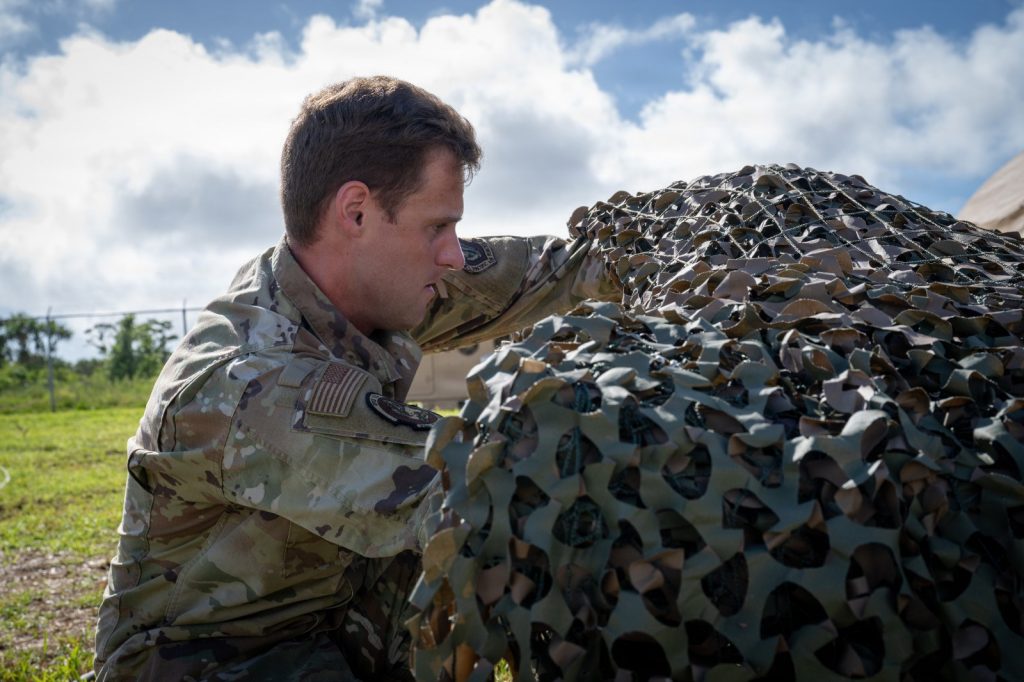
U.S. Air Force Airman configures a Starlink terminal in the Northern Mariana Islands
The Enemy on Your Own Network
Starlink’s value turned out to be legible to Russia too — a country for which the service is officially unavailable. Starting around 2024, Russian forces began experimentally fitting Starlink terminals to reconnaissance and strike drones specifically to defeat Ukrainian electronic warfare. By late 2025 and into early 2026, that experiment had become routine. Investigations by Der Spiegel, corroborated by Ukraine’s Defense Intelligence, alongside reporting from Defense Express, ISW, and Ukrainian defense-ministry adviser Serhii Beskrestnov, documented Starlink terminals mounted on Russia’s long-range BM-35 drones (with a range of up to 500 km), on “Molniya” drones, and on a portion of Shahed-type strike drones. BM-35s carrying Starlink terminals were tracked during strikes on Dnipro and Odesa in January 2026; Russia’s “Rubicon” unit has fielded Starlink Mini terminals on tactical drones since late 2025.
The terminals reach Russia despite sanctions, moving through parallel-import routes via third countries, notwithstanding SpaceX’s public position that it does not supply the Russian market. The appeal is technical as much as tactical: unlike GNSS signals, which are relatively easy to jam, Starlink’s narrow, high-frequency beams are difficult to suppress, and a terminal mounted on a drone keeps transmitting the aircraft’s position back through the satellite even at long range from its operator.
By February 2026, this had become untenable. Elon Musk announced the deactivation of Starlink terminals identified as operating on the Russian side of the front, and Ukraine introduced mandatory registration and verification — a “whitelist” — for all satellite terminals in its own networks, cutting off anything that failed the check.
War has taught Russia and China an unambiguous lesson about orbital infrastructure: whoever controls the satellite network can switch an opponent off at will, regardless of where that opponent’s hardware physically sits. That is the strategic conclusion both governments have drawn — and it is why both are racing to build constellations that Washington cannot reach with a policy decision.
It’s worth noting how this contest is playing out without a single weapon being placed in orbit. Control over communications, navigation, and reconnaissance data flowing through satellites is proving sufficient on its own.
Rassvet: An Answer That’s Behind Its Own Announcements
Russia’s low-orbit answer, “Rassvet,” is developed by Bureau 1440, a private aerospace firm founded in Moscow in December 2020 and part of the ICS Holding group. State media routinely calls it Russia’s answer to Starlink. Officially, the government has no stake in the company — but Bureau 1440 draws heavily on federal money regardless, with 102 billion rubles allocated through the national “Data Economy” program and another 329 billion rubles the company aims to raise on its own.
The speed with which Bureau 1440 went from founding to serial satellite production invites obvious skepticism about how much of the hardware is genuinely proprietary versus assembled from off-the-shelf Chinese components. One additional, unavoidable piece of background: 36 OneWeb satellites bound for launch from Baikonur were stranded in Russian hands after the 2022 invasion, when Roscosmos refused to release them following Britain’s decision not to sell its stake in OneWeb. OneWeb wrote the loss off entirely — roughly $229–230 million — and its leadership said at the time that the company had simply moved on. Whether or how much Bureau 1440’s engineering drew on those stranded satellites is impossible to verify from the outside, but the timeline is suggestive enough to be worth noting.
What matters more than any of that is orbital reality, which is checkable. Rassvet’s first serial batch — 16 satellites, launched on a Soyuz-2.1b/Fregat-M from Plesetsk — went up on March 23, 2026. The satellites were meant to climb from a roughly 300 km transfer orbit to an operational altitude of 800 km under their own plasma propulsion. That climb didn’t happen as planned. One satellite lost contact with ground control and burned up in the atmosphere by June. Independent tracking (n2yo, CelesTrak) and industry reporting put the rest of the batch at roughly 518–541 km as of early August — several hundred kilometers below the announced target, most likely because Bureau 1440 was forced to cap the operational altitude rather than push the satellites further.
That shortfall isn’t just a number. A constellation flying at ~520 km instead of 800 km needs roughly twice as many satellites to deliver comparable coverage, because each satellite’s footprint on the ground shrinks with altitude — and satellites that low decay faster, meaning the constellation has to be replenished more often just to hold its position. A second batch of 16 satellites reached orbit on July 20, still sitting on a low transfer orbit as of this writing. At two launches completed out of nine planned for 2026, Bureau 1440 would need to fly a Soyuz roughly every three weeks for the rest of the year to hit its own target of 156 satellites by December — a cadence with zero room for the kind of failure the program has already had once.
Set against that backdrop, Vladimir Putin’s public rhetoric has run well ahead of the hardware. At a Kremlin reception for Russia Day on June 12, 2026, he told military personnel that Russia already had its own Starlink equivalent, that it was no worse than the American original, and that the constellation was being deployed and would soon be felt by troops on the front line. Within days, Russian outlets were already describing operational use of Rassvet in the war against Ukraine. A constellation of roughly thirty working satellites sitting on the wrong orbit cannot deliver the coverage those claims imply. None of this makes Rassvet a failure — it’s a sanctioned, resource-constrained program that is genuinely moving forward, just considerably slower than its own press releases suggest, and without a stable working configuration yet. Full deployment, at roughly 292 satellites, is targeted for 2027; an expansion to 924 satellites is pencilled in for 2035. Starlink’s head start is measured in nearly a decade, and as of mid-2026 that gap isn’t closing anywhere near the pace the Kremlin describes.
Cutting Off the Launch Pad

FP-5 Flamingo missile on a ground-based launcher
That gap is now the object of direct Ukrainian military attention. RKTs Progress, the plant reportedly hit on August 15, produces the Soyuz-2 family — including the Soyuz-2.1b that has flown both Rassvet launches to date, and that Russia also uses for other military satellite payloads. It sits inside the Aviakor aircraft-plant complex in Samara and is, by most accounts, the only large production facility of its kind in Russia: roughly a kilometer of connected assembly halls covering every stage of building a Soyuz launch vehicle. Preliminary assessments point to the strike hitting the western end of the complex, where final assembly takes place — the stage where completed tooling, jigs, and partially assembled rockets are most concentrated and least replaceable. Rocket assembly is a manual, skills-dependent process; damage to tooling and to workers’ accumulated experience, not just to buildings, is what would actually slow output.
Since the start of the full-scale invasion, Russia has flown roughly six to eight Soyuz-2.1b missions a year. If the damage to Progress proves serious, Russia’s near-term alternative is the Angara family, built at the Polyot plant in Omsk — a line that has managed only nine launches since 2022 (two heavy Angara-A5s and seven light Angara-1.2s), nowhere near the cadence Rassvet’s own deployment plan assumes.
Ukrainian officials and analysts have been explicit that this is deliberate, not incidental. Andriy Kolesnyk, a former adviser to the head of Ukraine’s State Space Agency, has argued that Rassvet satellites need to be destroyed at the production stage, along with the means used to launch them, because Ukraine currently has no constellation of its own with which to contest Russian satellites once they’re already in orbit. Striking the launch vehicle’s only major assembly line is, in effect, the version of that strategy available today.
Jamming the Jammer’s War
There’s a genuine paradox sitting underneath all of this. As of mid-2026, the heaviest, most measurable Russian investment in counter-satellite capability isn’t aimed at building Rassvet — it’s aimed at jamming the American system that’s still working against Russia.
The system in question, “Volna Kupol Garant”, targets the 14–14.5 GHz uplink band Starlink terminals use, split across eight 62.5 MHz channels, with eight dedicated antennas — one per channel — barraging each passing satellite with high-power noise to deny reception from ground terminals. A single unit reportedly covers a radius of about 2.5 km (roughly 20 km²) and costs on the order of $1.5 million; the manufacturer is linked to “Rossiysky Kupol,” operating out of occupied Simferopol. Its weaknesses are structural: a high-power emitter is easy to locate by its own signature, so each unit needs mobile escort, air defense, and camouflage, and the system’s six trailers (two antennas each) take real time to power down, disconnect, and move.
Ukrainian forces have destroyed three of these complexes so far — twice on occupied territory in June, including near Kerch, and, for the first time, inside internationally recognized Russian territory on August 7, near Gelendzhik, at a facility identified by Ukrainian OSINT analysts (Dnipro Osint) using satellite imagery. The location carries its own symbolism: Gelendzhik is where one of Putin’s residences sits.
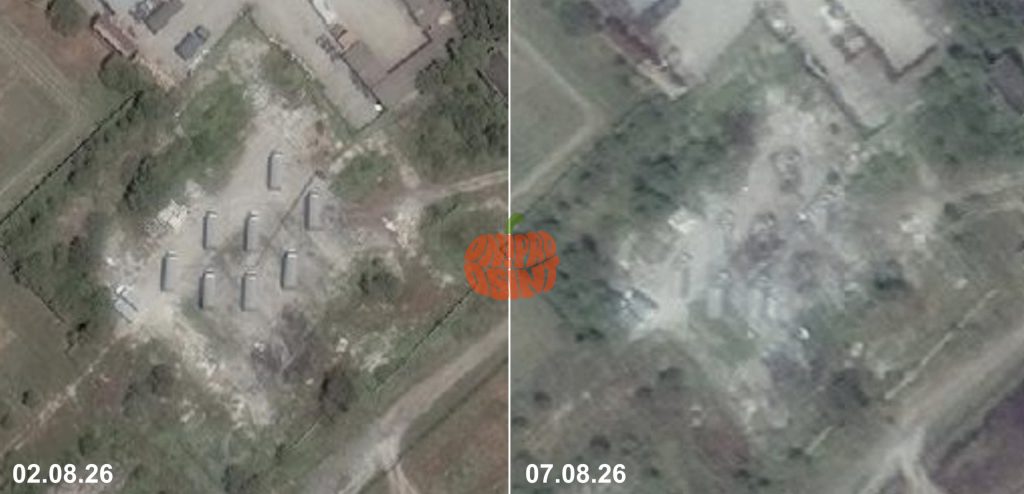
“Volna-Kupol-Garant” Electronic Warfare System. Satellite images before and after injury
The imbalance is worth stating plainly: Russia is spending more visible effort and taking more real losses trying to silence a working foreign satellite network than it has yet managed to show for building its own. That, more than any single claim in this piece, is the clearest evidence of how effective Starlink still is on this battlefield — and why Moscow’s most urgent countermeasure isn’t a constellation of its own, but electronic warfare against someone else’s.
On the Ukrainian side, the response to Rassvet itself is, for now, deliberately modest. Ukrainian developers have built a tool that forecasts and maps Rassvet’s geometric visibility windows over Ukrainian territory up to 72 hours out — essentially predicting when and from where the constellation can physically see a given stretch of front line. That’s tracking, not a fix: Rassvet doesn’t yet field enough working satellites, on a stable enough orbit, to pose the kind of threat that would justify a dedicated jamming system, which is part of why Beskrestnov has framed building electronic-warfare countermeasures against Rassvet as a task for now rather than a finished one — something to have ready before the constellation matures, not a problem that already needs solving.
Other Players: Europe and China
Russia and China aren’t the only ones racing for orbital independence. The European Union’s IRIS² constellation is officially framed around secure, resilient connectivity across Europe and its partners, including during crises when governments, emergency services, and citizens need to stay connected — and it’s classified within the EU’s own budget architecture under “defense industry and space,” a fairly direct acknowledgment that dependence on non-European connectivity infrastructure, the Ukrainian war chief among the lessons behind it, is part of what the program is meant to fix.
China is running two build-outs in parallel. China SatNet’s “Guowang” (“National Network”), led by China Satellite Network Group, is the country’s first mega-constellation and its first integrated space-air 6G plan, targeting close to 13,000 satellites across two sub-constellations using Ka-band and laser inter-satellite links. The U.S. Department of Defense has repeatedly flagged Guowang as capable of giving Chinese forces the kind of ubiquitous connectivity American forces already get from Starlink, with potential tactical implications for any conflict in the western Pacific. The second program, “Qianfan” (“Thousand Sails”), broke ground in 2024 and is aiming for 10,000–13,000 satellites by the mid-to-late 2030s, with more than 140 launches planned for 2026 alone as it races to establish baseline coverage well ahead of full deployment.
None of these programs is close to matching what Starlink already does today. But the direction of travel is consistent across every actor in this story: Russia jamming an American network it can’t replace, Ukraine hitting the factory that builds the rockets for a Russian network that isn’t ready yet, and the EU and China both building their own constellations explicitly so that no single company or government can decide, unilaterally, who gets to stay connected. The war in Ukraine didn’t invent that lesson. It just made it impossible to ignore.