
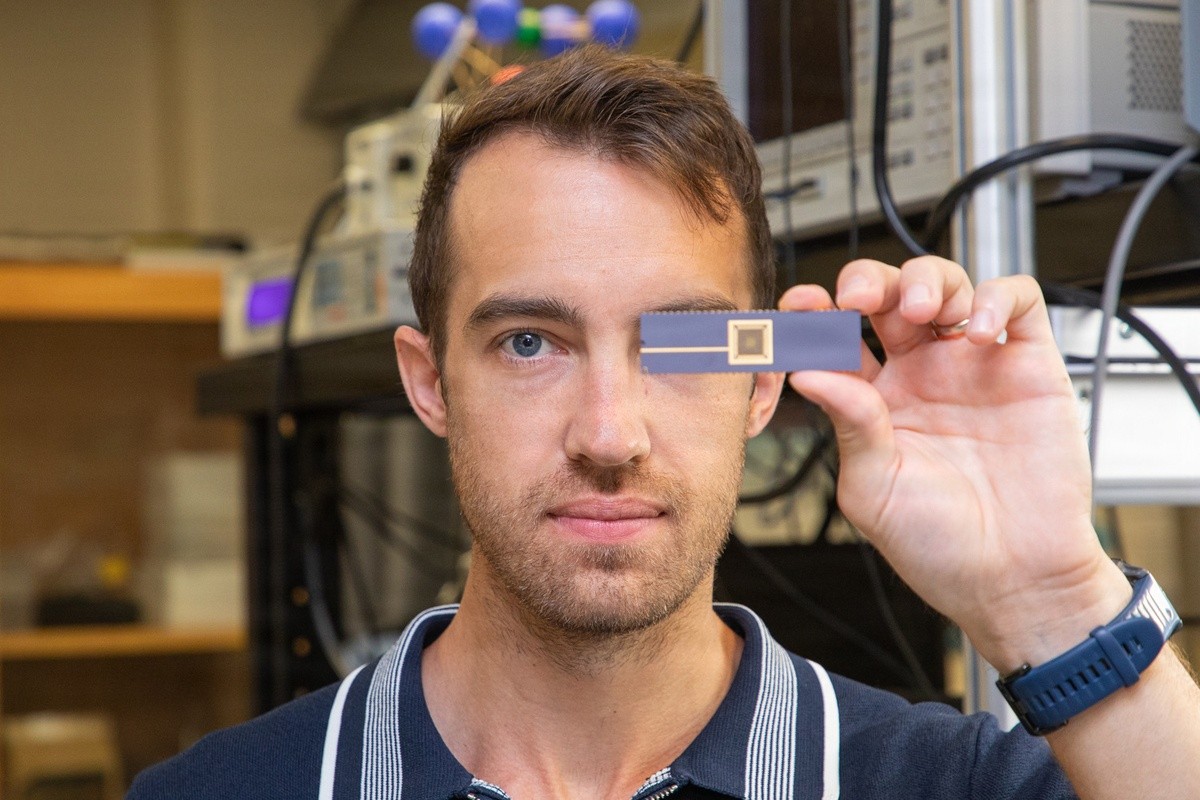
DEVCOM ARL researchers, in collaboration with industry and academic partners, have demonstrated a microchip memory cell capable of operating in extreme thermal environments up to 1000°C. The technological step forward addresses a long-standing vulnerability in conventional electronic memory, which fails or experiences critical data loss when exposed to high temperatures.
Standard electronic components present a major bottleneck for modernizing military platforms, including helicopters, missiles, and small modular nuclear reactors. To solve this gap, researchers from the U.S. Army Combat Capabilities Development Command Army Research Laboratory tested a thin-film ferroelectric material called Aluminum Scandium Nitride, or AlScN. The material retains its internal electrical charge states without power across a temperature range from room temperature up to 1000°C. Tests showed that as operating temperatures rose, the voltage required to switch memory states decreased, potentially offering higher energy efficiency at extreme heat.
Integrating high-temperature digital microelectronics directly into engine control units enables distributed computation near sensors and jet turbines. According to Dr. Daniel Drury, an ARL research materials engineer involved with the project since 2022, placing digital controllers directly on engines removes reliance on bulky cooling systems, eliminates heavy analogue cabling, improves system response times, and expands the operational envelope of aircraft. Industry partners noted that monolithic integration of this memory technology removes the need for off-chip memory modules and heavy thermal packaging.
The research team included partners from NASA Glenn Research Center, GE Aerospace, University of Arkansas, and Colorado School of Mines. Following material validation, current efforts focus on scaling up production using a new AJA sputter deposition system at the ARL headquarters cleanroom to ensure material cleanliness and consistency for industrial transfer. Beyond defense platforms, the heat-proof chip technology holds potential application for field-deployable geothermal energy systems.