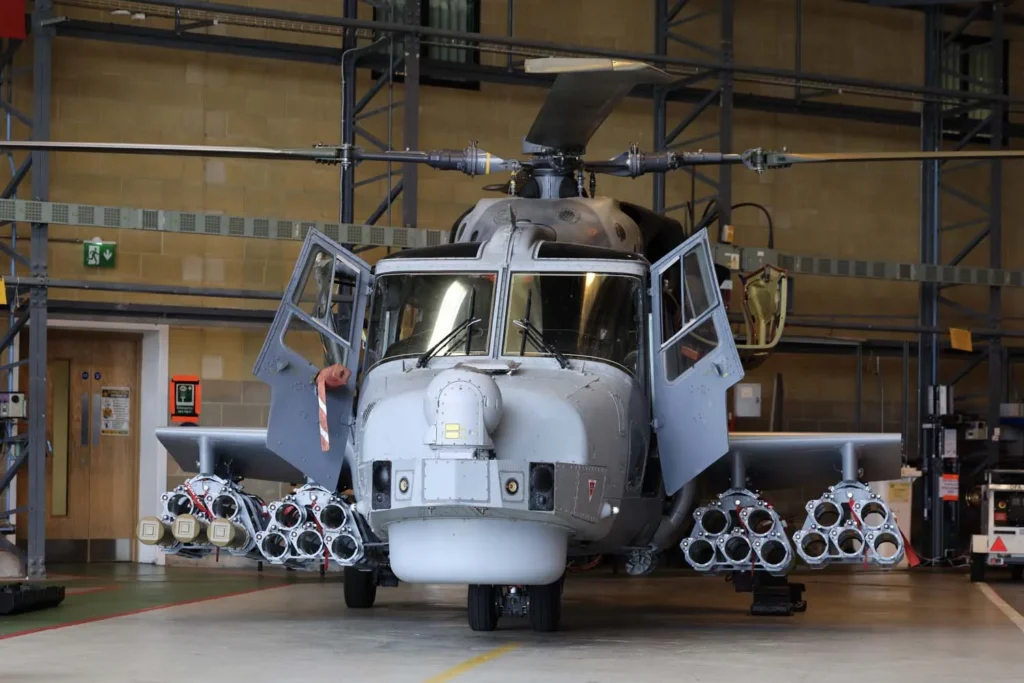
The Royal Navy has confirmed that its low-cost autonomous network is ready for operational deployment, allowing warships, Wildcat helicopters, Royal Marines, and uncrewed systems to fight as a unified force. The breakthrough follows the completion of exercise Dragon Rider across southern England, which demonstrated that operators could share real-time intelligence, designate targets, and take remote control of drones over long distances using a resilient communications architecture.
At the core of the system is a Mobile Ad-hoc Network (MANET), a self-healing mesh architecture that automatically reroutes data if links are jammed or disrupted. Built on lessons learned from the war in Ukraine, the network functions as a universal translator, enabling sensors and uncrewed platforms from various manufacturers to communicate seamlessly through a single interface. During the trials, information from multiple aerial drones was routed through a sensor-equipped Wildcat helicopter acting as a flying command center, streaming live video to a central hub at RNAS Yeovilton across a distance exceeding 200 miles.
According to official announcements, the operationalization of this mesh network removes traditional radio range limitations and significantly enhances crew survivability by pushing uncrewed assets further ahead of frontline forces. Developed in collaboration with small and medium-sized technology firms from the UK, the US, and Norway, the system will next incorporate satellite communications to enable command-and-control over vastly greater operational ranges.