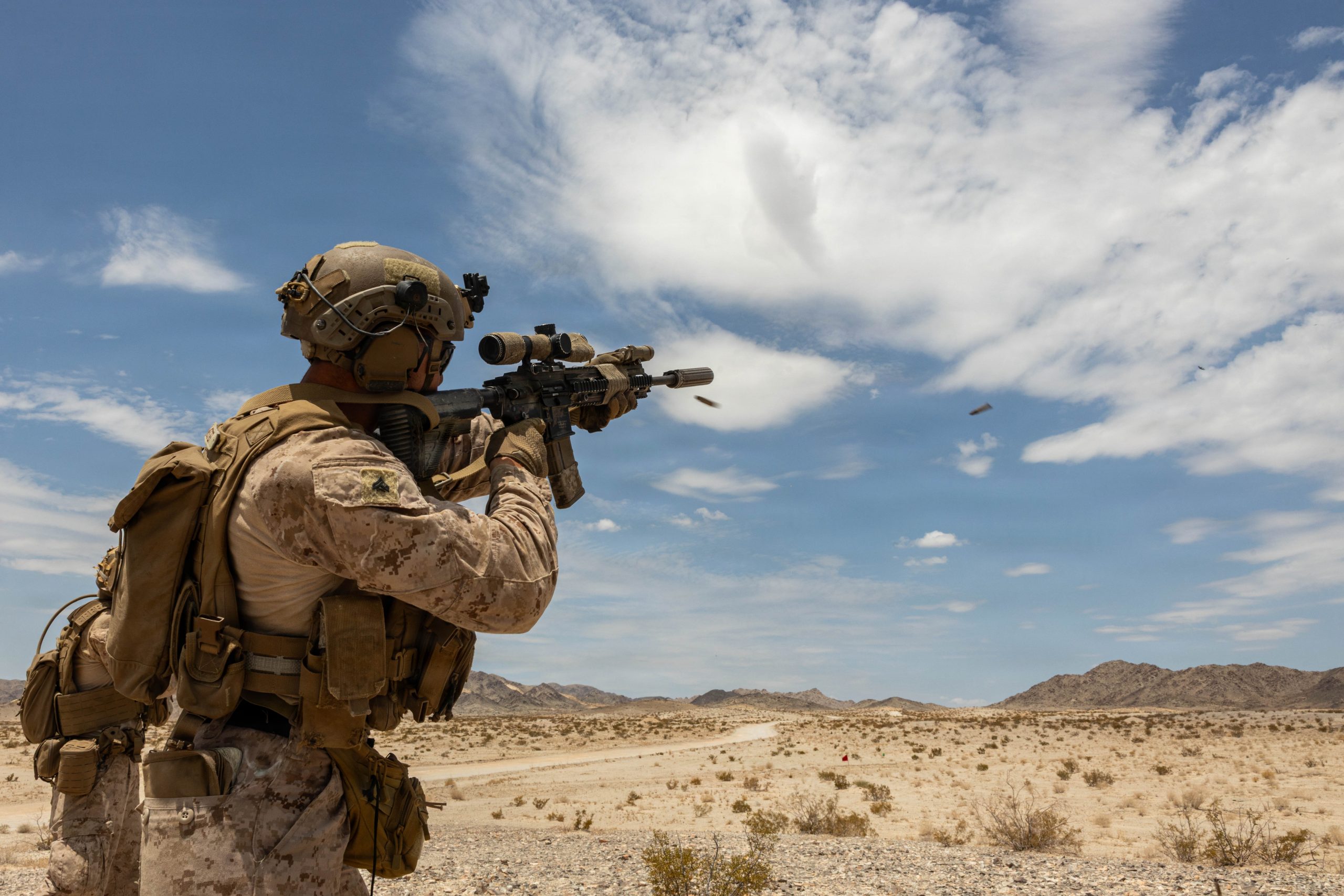
The US Marine Corps launched its first dedicated counter-small uncrewed aerial systems (C-sUAS) training lanes and operational integration during Service Level Training Exercise 4-26 on July 15, 2026.
Participating formations from the 1st and 2nd Marine Divisions incorporated counter-drone protocols across nearly every exercise segment at the Marine Corps Air Ground Combat Center. The program combined a three-day introductory course—featuring classroom instruction, practical application, and live-fire lanes—with sustained sUAS friction throughout urban clearing and mounted patrol scenarios.
Instructors from the Tactical Training and Exercise Control Group (TTECG), known as “Coyotes,” simulated realistic enemy sUAS activity to train Marines in denying, detecting, and defeating low-cost drone threats. To provide accurate operational threats, TTECG partnered with Marines from the 7th Marine Regiment and 3rd Light Armored Reconnaissance Battalion, who completed a three-week course focused on tactical FPV drone flight operations.
During live-fire engagements, Marines engaged target drones traveling at speeds exceeding 90 miles per hour at distances as close as 20 meters. The forces combined electronic warfare capabilities with organic infantry weapons, including M27 infantry automatic rifles firing 5.56 mm ammunition, M1014 combat shotguns with 12-gauge shells, and M32A1 and M320 grenade launchers firing low-velocity 40 mm anti-personnel rounds.
Exercise commanders noted that small uncrewed aerial systems have reshaped battlefield dynamics due to their low production costs and widespread utility for intelligence, surveillance, and direct strikes. Moving forward, the Combat Center will retain integrated sUAS and C-sUAS lanes as standard components of future exercises to ensure units return to home stations with established counter-drone tactics, techniques, and procedures.