The UK Ministry of Defence has launched Project PANOPTES to develop an autonomous vehicle-mounted laser air-defense system designed to defeat drone swarms and repeated low-cost unmanned aerial system attacks without rapidly depleting expensive missile stocks. Announced on September 2, 2026, the program is the first phase of a planned multi-stage acquisition pathway that could lead to a formal Program of Record to protect maneuver forces against dense drone saturation.
The MOD requirement calls for an integrated system able to detect, track, identify, decide, and defeat aerial threats while operating autonomously from an Army vehicle. Its initial target set comprises Class 1 UAS, addressing simultaneous and sequential attacks intended to overwhelm local defenses. A laser-based solution offers a distinct advantage against sustained attacks because engagements are constrained primarily by electrical generation, thermal management, and maintenance rather than finite missile or cannon ammunition, shifting the economics of short-range air defense where inexpensive reconnaissance and attack drones far outweigh the costs of conventional surface-to-air missiles, stated the UK official portal for government procurement and defense innovation.
For the British Army, the operational objective is to create affordable combat mass for short-range air defense, allowing a directed-energy weapon with sufficient power to engage repeated low-cost threats while preserving missiles for cruise missiles, helicopters, or larger aircraft. Because maneuver formations require a system that remains mobile, reacts rapidly, and sustains multiple engagements while moving with armored units, PANOPTES requires open architecture, modularity, and host-vehicle electrical power to allow sensors, command-and-control functions, and effectors to evolve alongside emerging drone threats.
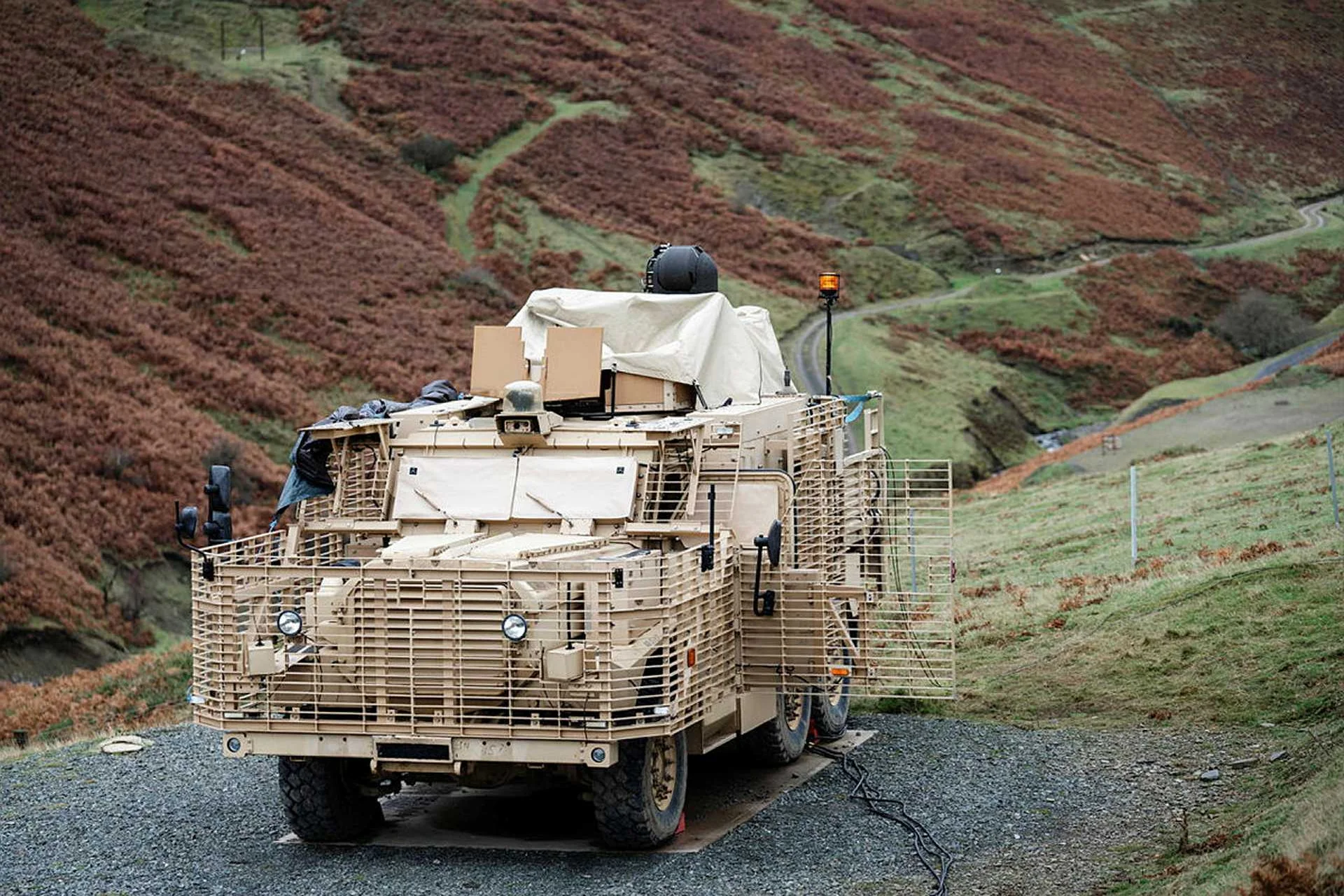
The project builds directly upon the British Army’s Land Laser Directed Energy Weapon Demonstrator program, which in July 2024 involved a Raytheon UK-led high-energy laser fired from a Wolfhound protected mobility vehicle at Porton Down, neutralizing targets beyond one kilometer. Following engineering trials, personnel from 16 Royal Artillery tested the system at Radnor Range in December 2024 to track and destroy flying drones, demonstrating a laser that operates with a two-person crew and relies on advanced sensors and tracking to maintain a real-time aim point.
PANOPTES shifts the focus from demonstrating a vehicle-mounted laser to developing an integrated counter-UAS capability featuring autonomous decision-making to prevent human operators from becoming a bottleneck when multiple threats arrive within seconds. Future integration onto an uncrewed ground vehicle is also planned, potentially allowing directed-energy nodes to operate closer to exposed forward units while reducing personnel exposure.
Phase 1 of the procurement will mature existing technologies and evaluate candidate solutions for deployability rather than buying a completed weapon immediately, with up to £5 million available for multiple contracts and work scheduled to begin in late 2026. The MOD is encouraging proposals that can accelerate into operations in under two years, seeking mature technologies to provide a new layer of mobile short-range air defense for British Army and Joint Ground-Based Air Defense under sustained UAS threat.