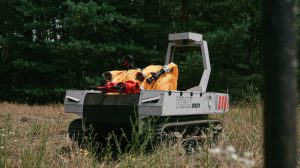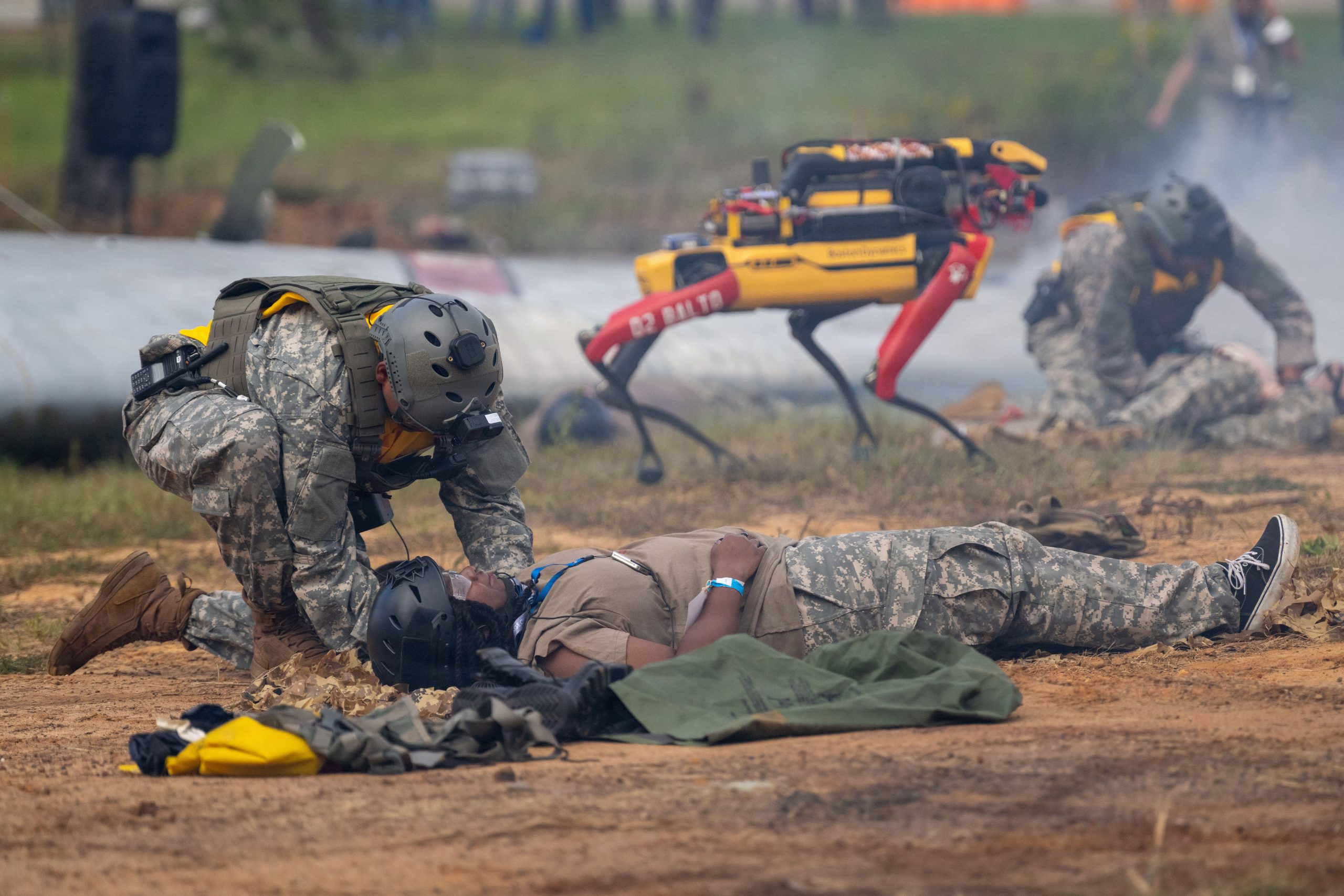
In August 2017, at the Narragansett Bay Test Facility in Newport, Rhode Island, an autonomous boat delivered a small ground robot to a stretch of beach. The delivery was part of the Advanced Naval Technology Exercise, a recurring test event run by the Naval Surface Warfare Center’s Indian Head Explosive Ordnance Disposal Technology Division to evaluate emerging unmanned systems. A converted Advanced Composite Riverine Craft ferried an EOD unmanned ground vehicle ashore, where it carried out simulated threat detection and neutralization under a mix of semi-autonomous and remote control.
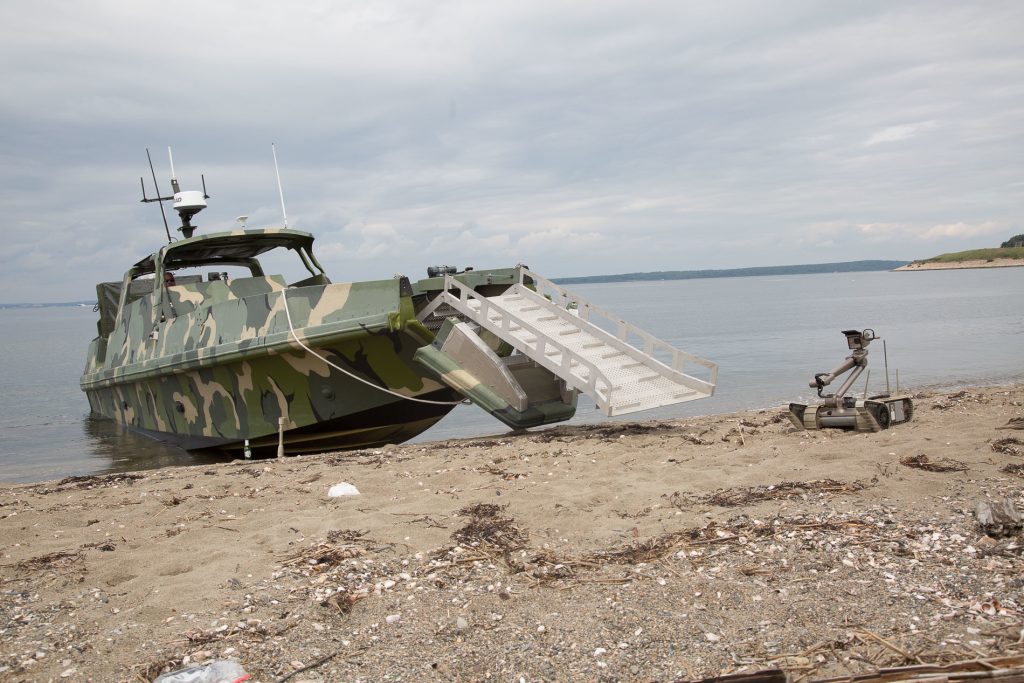
An autonomous boat delivers an EOD UGV to the beach during the 2017 Advanced Naval Technology Exercise in Newport
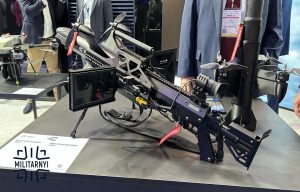
Nine years later, on July 13, 2026, Ukraine’s 123rd Separate Territorial Defense Brigade delivered a ground robot to a beach the same way — by unmanned boat — but with a different payload entirely. The platform carried a remote-controlled ground robot armed with a “Wolly 7.62” combat module built around a PKM machine gun to a stretch of Russian-occupied coastline on the Kinburn Spit in Mykolaiv region. The robot opened fire on Russian positions along the shore, then self-destructed, as it had been rigged to do. “The first known combat mission of this format in the world: a ground robotic complex was delivered to the enemy shore using an unmanned marine platform, exploded on occupied land in our home region, and used to complete a combat task,” the brigade said in its statement, adding that the naval platform let them reach terrain no soldier could safely approach on foot.
A decade in the making
The Kinburn Spit strike fits into a longer, slower story of how the U.S. military has approached ground robots — one that broadened gradually in scope long before Ukraine’s war forced the pace. The earliest documented mention in the U.S. Army’s own public record dates to June 2008, when officials described a “small, unmanned ground vehicle” as part of a package of Future Combat Systems technologies being rushed to infantry brigades fighting in Iraq and Afghanistan. In August 2019, the U.S. Army and the UK’s Defence Science and Technology Laboratory jointly demonstrated autonomous “last-mile” resupply at Camp Grayling, Michigan, pairing robotic versions of full-size vehicles like the HMMWV for bulk convoy movement with the UK’s smaller Viking ground robot for the final delivery leg — an early attempt to keep soldiers out of exposure to enemy fire during resupply runs. For most of the years between, American coverage of ground robots stayed thin and narrow in scope, focused almost entirely on demining and patrol.
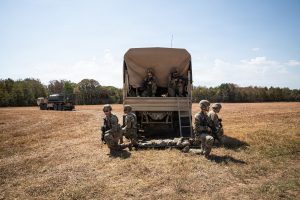
It took until December 2023 for the U.S. Marine Corps to test a dedicated small UGV prototype of its own for a logistics role, when the 3rd Littoral Logistics Battalion evaluated one at Marine Corps Training Area Bellows in Hawaii. Just a month later, the Army Expeditionary Warrior Experiment at Fort Moore featured a Milrem THeMIS fitted with a remote-controlled weapon station — an armed UGV. From 2025, coverage of ground robots picked up so quickly that the past year alone produced roughly as many mentions as the entire decade following that first 2008 reference.
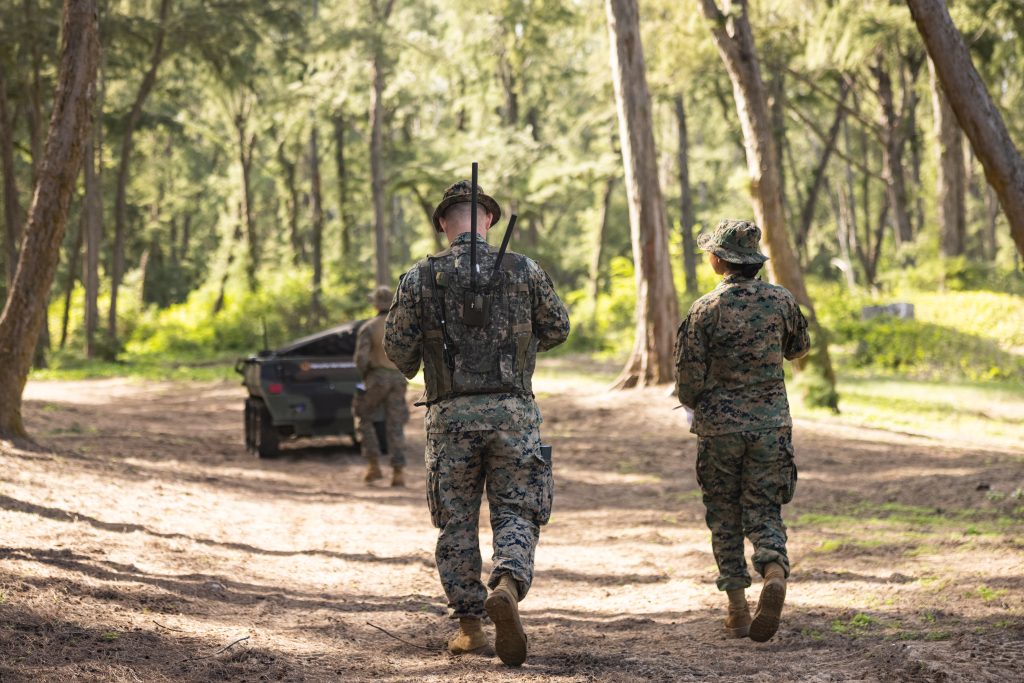
U.S. Marines operate an unmanned ground vehicle prototype
Read against that backdrop, Kinburn looks less like an isolated tactical improvisation and more like the leading edge of a trajectory that had already been building for years: ground robots moving from a niche EOD tool, to a logistics asset, to an armed platform — with Ukraine’s war simply compressing a multi-decade curve into a matter of months.
Where the curve went vertical
Ukraine’s own numbers describe the same curve, at a far steeper angle. Ground robot missions were isolated experiments through 2023 and 2024, limited mostly to demining and one-off logistics runs. That changed sharply in 2025: Ukrainian industry delivered roughly 15,000 UGVs to frontline units, up from about 2,000 the year before — a 488 percent expansion, according to a joint study by the KSE Institute, Brave1, and Defense Builder. The number of military units operating UGVs climbed from 67 in November 2025 to 230 by mid-2026. Ukrainian forces carried out roughly 7,500 ground-robot missions in January 2026 and 16,676 in June — more than double in five months — with over 66,300 combat and logistics missions completed in the first half of the year. Ukraine’s defense ministry has set a goal of moving up to 100 percent of frontline logistics onto robotic platforms, and plans to contract roughly 25,000 UGVs in the first half of 2026 alone.
The most direct explanation for that scale-up is tactical. FPV drones, especially fiber-optic variants immune to jamming, now hunt anything that moves in a belt of territory 10 to 30 kilometers deep along the line of contact — a zone soldiers on both sides call the “kill zone.” Roads passable “almost casually” eighteen months ago are now driveable, by soldiers’ own accounts, mainly in rain, snow, or fog, when drone optics degrade. Trucks stopped working in that zone; ground robots, cheap and expendable by comparison, filled the gap.
Once robots were operating at that density, their role began expanding well beyond logistics. A DevDroid combat robot armed with a machine gun held a frontline position near Kharkiv for 45 days in December 2025, reloading and undergoing maintenance every 48 hours with no soldier ever occupying the position. Ukraine’s K2 Brigade has stood up what the BBC describes as the world’s first dedicated UGV battalion. In August 2026, operators from the 44th Separate Mechanized Brigade drove a DevDroid Droid TW-12.7, armed with a .50-caliber M2 Browning, up to a Russian-occupied building and opened fire, killing 20 soldiers inside, entirely by remote control. On the Dobropillia axis, the 93rd Separate Mechanised Brigade deployed a UGV fitted with a flamethrower to clear a Russian-held tree line. Manufacturers now offer platforms carrying combined machine-gun and grenade-launcher mounts, and say anti-tank missile carriers and autocannon variants are in development for 2026.
The pattern reflects a manpower problem Ukraine has openly acknowledged: after more than three years of war, robots increasingly fill roles that would otherwise require soldiers, keeping people out of the kill zone and off assault lines robots can run instead.
The United States: testing catches up in 2026
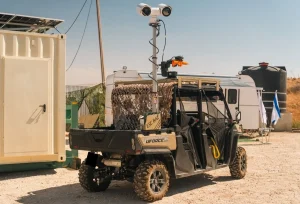
The same widening of scope shows up in U.S. Army testing, on a longer timeline. In April 2026, a Hunter Wolf UGV assigned to the 101st Airborne Division — mounted with a remote-operated .50-caliber machine gun — held an overwatch position during a combat simulation at the Joint Readiness Training Center. The Hunter Wolf had already been selected for the Army’s Small Multipurpose Equipment Transport (S-MET) program, whose original mandate was hauling gear for dismounted infantry; it’s now also being tested as an armed sentry. A month earlier, the 2nd Cavalry Regiment ran xTech | Edge: Ground Strike at Grafenwoehr, Germany, testing UGV submissions from developers worldwide against soldier feedback, part of an Army prize-competition initiative built to accelerate autonomous ground capability.
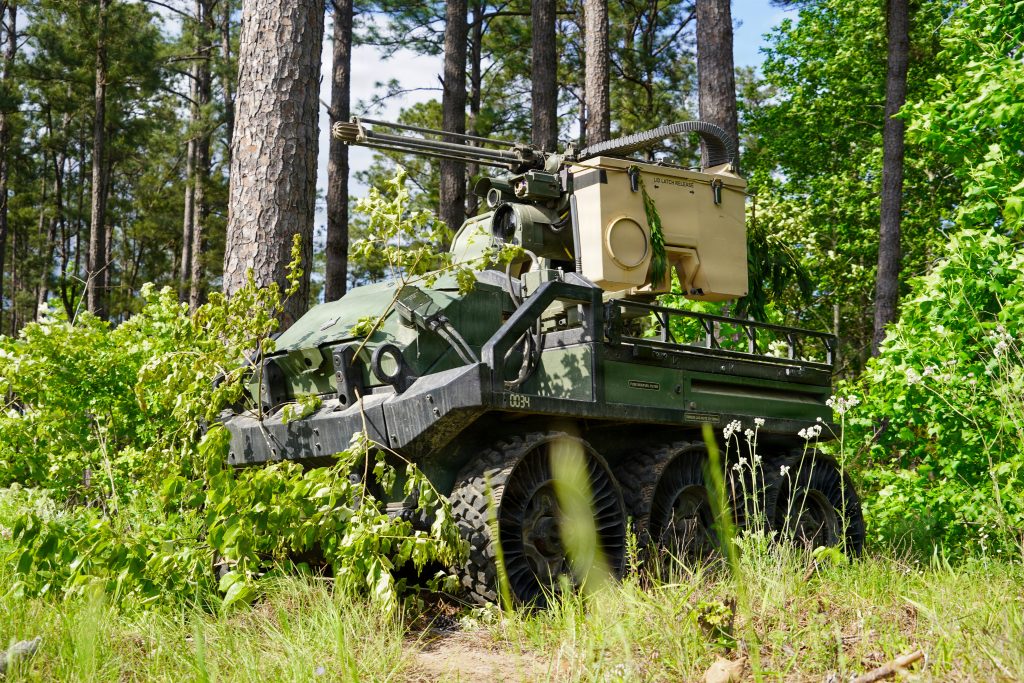
A Hunter Wolf UGV with a mounted remote-operated 50-caliber machine gun. Fort Polk, April 2026
Europe: fast programs, slow fielding
European militaries have moved from curiosity to active fielding, driven by proximity to the war. In May 2026, NATO’s Crystal Arrow exercise in Latvia tested ground robots from five countries, including Ukraine’s own UGV Laboratory, whose Simba platform took part in a NATO exercise for the first time under the Eastern Flank Deterrence Initiative’s Task Force X. National programs are multiplying: France’s FURIOUS and AUROCHS, the UK’s ATILLA and THESEUS, Germany’s ARX Gereon, Poland’s KUNA. The EU-backed Integrated Modular Unmanned Ground System (iMUGS) program, led by Estonia’s Milrem Robotics, is scaling toward a follow-on iMUGS2 consortium. Even so, European fielding trails Ukraine’s by a wide margin — Milrem has only about 70 vehicles actually operating inside Ukraine, a fraction of what Ukrainian manufacturers alone now produce annually.
Asia: robots against a demographic clock
Taiwan offers the closest parallel to Ukraine’s stated reasoning, minus the active war. Having become a “super-aged society” in 2026, with more than a fifth of its population over 65, Taiwan unveiled armed and reconnaissance-capable robot dogs in June 2026 for patrolling remote South China Sea outposts — an explicit attempt to offset a shrinking pool of military-age citizens with unmanned systems. South Korea fielded its K-CEV unmanned combat engineering vehicle for the first time in live-fire training in February 2026. China’s investment spans robotic platforms shown at military parades, submarine-launched underwater drones, and August 2026 exercises in which armed Chinese ground drones practiced destroying unmanned surface vessels — training read by analysts as preparation for the kind of drone defenses Taiwan and the U.S. are building, with Chinese military writing explicitly citing lessons from Ukraine’s war.
Forecasts versus the front line
Market analysts disagree sharply on how big the UGV sector will get, largely because they scope it differently. Narrower estimates, covering uncrewed ground vehicles specifically, put the global market at $3.2-4.3 billion in the mid-2020s, growing to $5-9.5 billion by the early-to-mid 2030s. Broader “military robots” figures, which fold in aerial and maritime systems alongside ground platforms, run much higher — from roughly $20 billion today to $30-33 billion by 2030, with one outlier forecast reaching $43 billion by 2034. Nearly every study agrees on one point: Asia-Pacific is the fastest-growing regional market, expanding at 11-22 percent annually, even though North America still holds the largest overall share.
Those projections may already be behind the reality on at least one battlefield. Ukrainian manufacturer Tencore has estimated, based on a brainstorming exercise with a military unit, that fully equipping every Ukrainian unit with UGVs would require around 40,000 robots a year — a single company’s back-of-envelope estimate for one country’s needs, already approaching what some global forecasts project for the entire industry within the next several years. Whether the rest of the world’s militaries close that gap by procurement or by war is, at this point, still an open question.