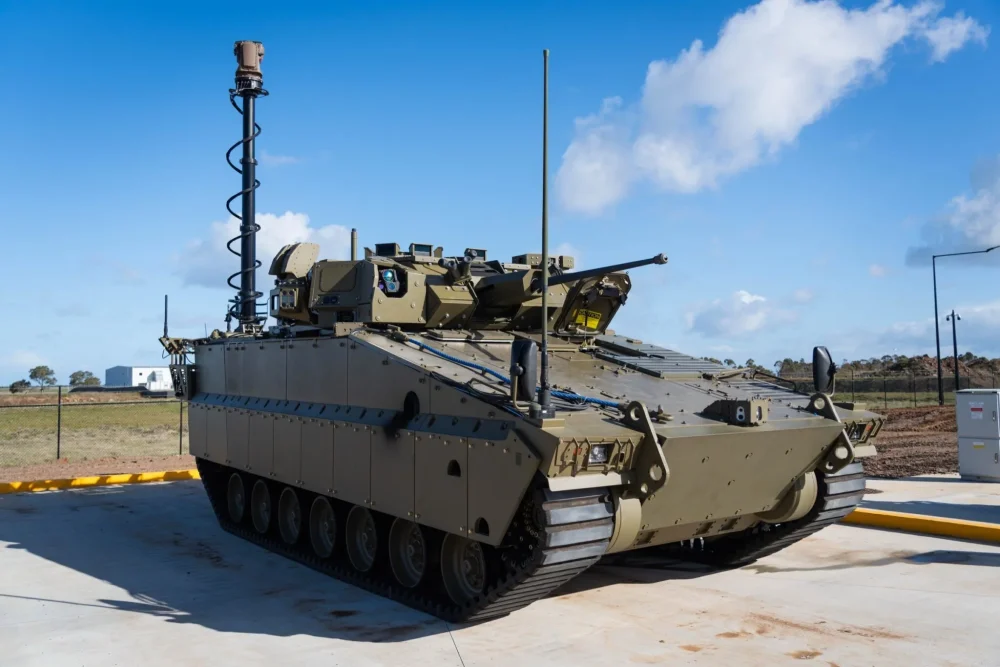
Australian company Visionary Machines and Hanwha Defence Australia have begun a new phase of joint development to assess the integration of the Pandion Sentinel passive drone detection system on the AS21 Redback infantry fighting vehicle.
Pandion Sentinel is designed to detect, track and classify unmanned aircraft. The system uses passive optical sensors and does not emit radio signals, allowing it to operate without active emissions.
According to Visionary Machines, the system uses a multispectral sensor array combining RGB, near-infrared, short-wave infrared and long-wave infrared bands. It can determine the location, direction of movement and speed of multiple drones.
Pandion Sentinel is designed to operate against Group 1–3 drones. For Group 1 drones, the company states a critical detection range of more than 1 km, while the system consumes less than 250 W of power.
The system can be mounted on vehicles, tripods or semi-permanent positions. Its architecture also allows data exchange with third-party command-and-control systems and counter-drone effectors.
The new phase of work continues the cooperation established under a memorandum of understanding between Visionary Machines, Hanwha Defence Australia and Hanwha Systems. The agreement was signed during the Avalon International Airshow in March 2025.
Visionary Machines and Hanwha Defence Australia will present their joint work at the Land Forces International Land Defence Exposition, which will take place in Perth from October 6–8, 2026.