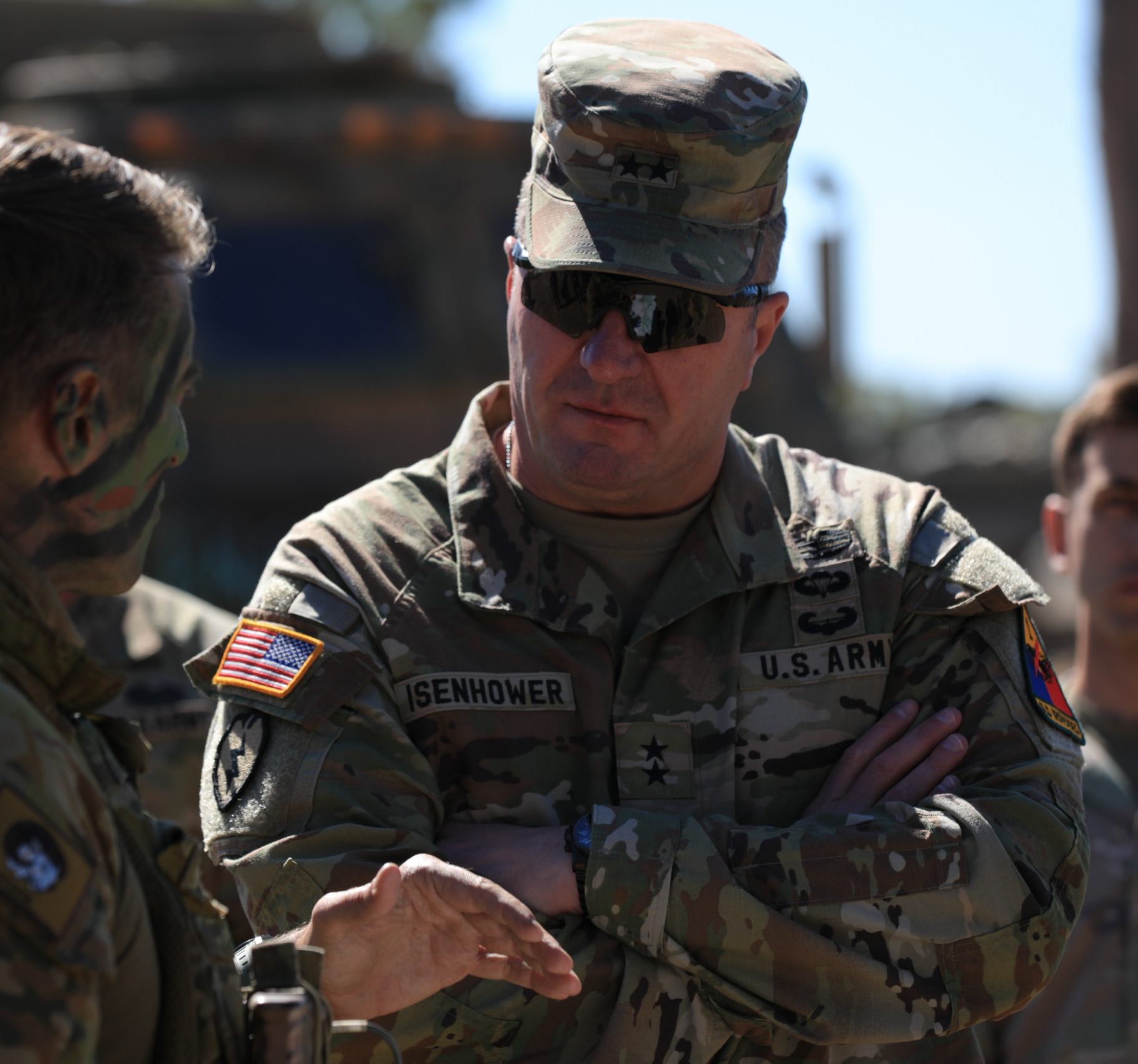
Remarks by Lt. Gen. James P. Isenhower III during a media briefing on how the Army’s Combat Training Centers are modernizing for large-scale combat operations.
Asked about the biggest shift shaping how the Army trains today, Isenhower pointed to something more fundamental than any single piece of equipment. “One of the things that’s been stark to me is the collective recognition that we don’t enjoy air superiority in a tactical environment,” he said. “For 20 years, we didn’t have to worry about anything coming out of the sky. And we lost proficiency that I think we had trained in the Cold War era… where we were worried about adversaries who had fixed-wing aircraft and the capability to send long-range precision fires at us.”
That shift is now reshaping training at both of the Army’s premier combat training centers — the National Training Center at Fort Irwin, California, and the Joint Readiness Training Center at Fort Johnson, Louisiana. Under Isenhower’s Combined Arms Command, rotational units now face pervasive drone surveillance and simulated aerial strikes throughout their exercises, forcing commanders and squad leaders alike to adapt. “I’ve witnessed a sea change in how those units employ, how they seek dispersion, and how they use terrain and other camouflage techniques, but also incorporate deception to present a dilemma to an opposing force that has an air capability,” he said.
The centers themselves are also being repurposed. Established in the early 1980s for force-on-force maneuvers against a free-thinking opposing force, the CTCs pivoted during Iraq and Afghanistan toward mission-rehearsal exercises built around counterinsurgency. Isenhower described the current shift as a return closer to their original purpose, but with a new layer added: rotations are now also a controlled environment for testing which emerging technologies actually work under realistic conditions. “It becomes an appropriate balance of building readiness and large-scale combat expertise, while also giving us an opportunity to integrate some experimentation where we can validate or invalidate the technology or the technique,” he said.
That balance is deliberately managed to avoid a specific failure mode Isenhower has seen before: soldiers so consumed with figuring out how new equipment works that they lose focus on their actual mission. “We’ve established a temporal threshold 180 days out where we have to give them that equipment then, so that they have sufficient time at home station to integrate it,” Isenhower said. “Then ostensibly, they can focus less on the integration of that equipment during the CTC rotation and more on fighting the enemy to good effect.” Technology that needs faster testing than that window allows gets pushed instead to the permanent opposing force at each center, which Isenhower said absorbs new commercial drones, electronic warfare emitters, and sensors more easily — doubling as a live-fire testbed and, for the rotational unit, a more realistic adversary modeled on the transparent, drone-saturated battlefields seen in Ukraine and other conflict zones.
Isenhower was equally direct about how the Army decides whether any of this technology is actually worth keeping. Rather than relying on vendor claims, the command embeds Transformation Lessons Learned Managers directly into training rotations to collect firsthand feedback from soldiers — including granular observations, like commercial drones that perform well in humid Louisiana weather but struggle in European winter cold. “The ultimate arbiter for me of an effective piece of technology is the soldier’s confidence in that technology and whether or not it’s helping them perform their mission,” he said. “If a soldier doesn’t have confidence in a piece of equipment, he’ll discard it.”
Source: DVIDS