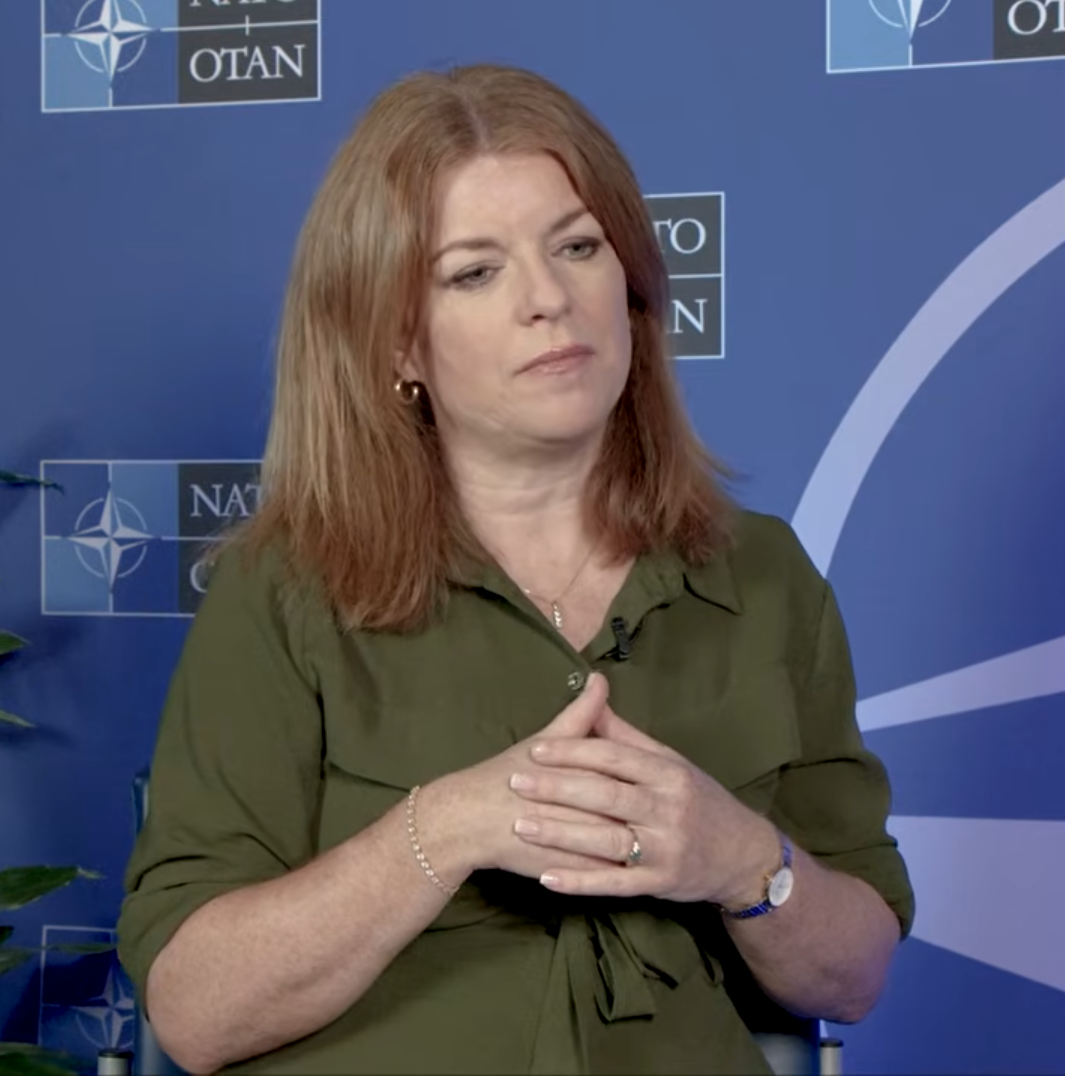
A retelling of remarks by Samantha Paarlberg, Head of Digital Transformation at NATO’s Allied Command Transformation (ACT), during her conversation on the Transformation Brief with host Jackie Fay Burton.
Asked what digital transformation actually means for NATO, Paarlberg was quick to push back on the assumption that it starts with technology. The scope of the term is massive, she said — it could mean almost anything — but at its core, the goal is to keep NATO relevant to the war fighter and to the roughly one billion people the alliance serves. That, she argued, is as much a people problem as a technical one: “it’s about the people change as much as it is about the technology.”
For transformation to succeed, Paarlberg said, it takes more than rolling out new technology — it takes a genuine shift in mindset, driven both top-down and bottom-up. She described that as moving from a fixed mindset to a more open, growth-oriented one, paired with a cultural shift toward “fail fast”: trying something, accepting when it doesn’t work, and moving on rather than treating failure as something to avoid. That, in her view, requires organizations to raise their risk appetite and give people real psychological safety to experiment in the first place.
None of this, she stressed, is really about access to tools. Having dozens of thousands of tech tools at your fingertips means little if people don’t change how they use them — she compared it to owning a highly advanced phone and only ever using it to make calls or send messages. The real question, as she put it, is how people apply themselves in an environment she described as very volatile. Her conclusion was direct: “we need to make sure that we as a people are dynamic as much as technology is.”
Made concrete, she pointed to decision-making speed as an example of where this plays out. Fast, trustworthy decisions depend on having the same validated data in front of everyone across NATO’s 32 member nations — what she called operating “at the speed of relevance.” To get there, ACT is building what she described as an ecosystem of trusted data — a mix of data mesh, data catalogs, and federated systems — that can plug into various tools, Palantir among them, regardless of which platform a given user is on.
That data ecosystem, known as the Alliance Data Sharing Ecosystem (ADSE), is a North Atlantic Council-approved initiative rather than an ACT-only effort, Paarlberg said, and it’s already being tested in exercises such as Bold Quest and the Coalition Warfare Interoperability Exercise, with Sea Witch planned for next year. Getting 32 nations aligned around it runs through a monthly Digital Transformation network, where national representatives take turns presenting their own data strategies and comparing notes — a process she framed as building trust as much as building infrastructure.
Training is the other half of the equation, in her view. Improving digital literacy means rethinking how both war fighters and NATO staff are taught to use new tools, including adaptive, machine learning-driven training designed to adjust to each individual’s pace. Looking five years out, Paarlberg described a flatter, more autonomous NATO organized around cross-functional, multi-skilled teams rather than fixed departments — with today’s push on cloud and AI giving way, eventually, to quantum. Transformation, she said, isn’t a project with an end date; it’s continuous.