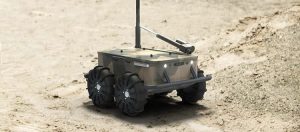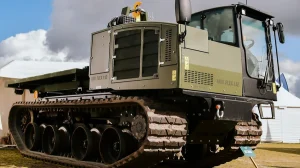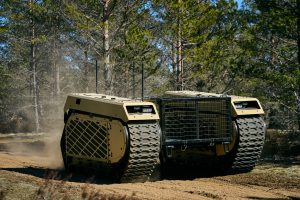
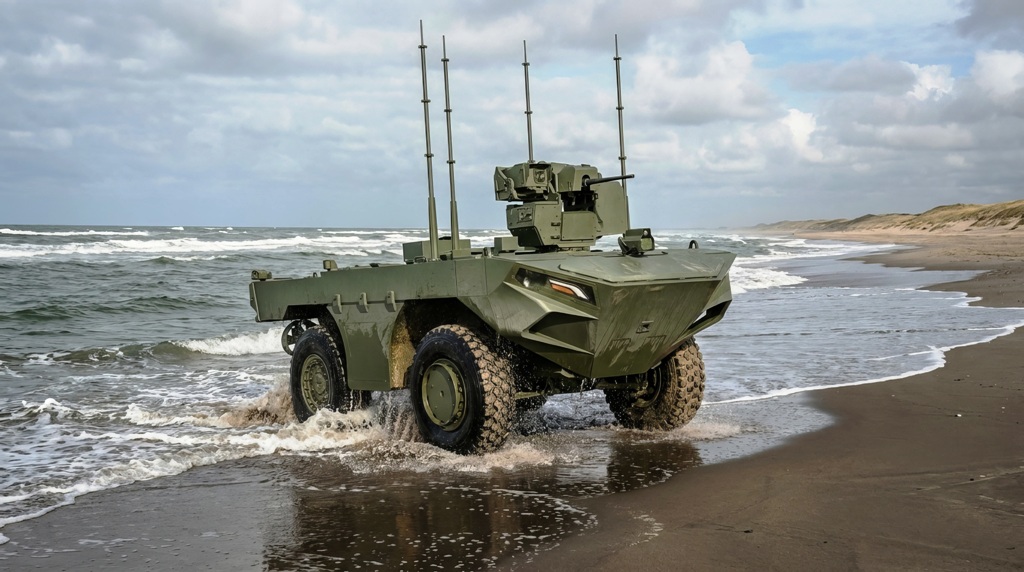
Turkish defense contractor FNSS has presented an eight-ton unmanned amphibious assault vehicle, designated U-MAV, at the TEKNOFEST Mavi Vatan event hosted at the Gölcük Naval Shipyard Command. Built to deploy ahead of manned Marine Assault Vehicles, the platform is engineered to engage shore defenses during the initial wave of an amphibious assault, removing human crews from the highest-risk phase of beachhead operations. The platform reaches speeds of 7 knots in water and 70 km/h on land, powered by a 300-horsepower engine.
As reported by Anadolu Ajansı, the platform features field-swappable mission modules that can be reconfigured in approximately 40 minutes across 10 operational roles, including direct fire support, mine clearance, electronic warfare, and logistics support. FNSS CEO Selim Baybaş noted that the vehicle combines established marine assault engineering with heavy-class autonomous technology. The vehicle operates via autonomous, remote-controlled, or hybrid modes, relying on an encrypted mesh network, satellite navigation, and an inertial navigation system to preserve positioning during signal jamming. Line-of-sight range is rated at 3 km and can be extended using aerial drone relays.
To optimize operational bandwidth, the vehicle’s mission computer processes real-time camera feeds onboard, transmitting key detection data and threat-scored target indicators rather than raw video streams. Additionally, U-MAV is the first unmanned system to integrate the Armor Integrity monitoring module developed by Nurol Teknoloji. Because no crew is present to evaluate physical damage, onboard sensors calculate structural capacity following impacts and transmit diagnostic data to operators once connectivity is established. The platform is transportable by road, rail, sea, and strategic airlift aircraft, though FNSS has not disclosed pricing, production schedules, or active purchase contracts.