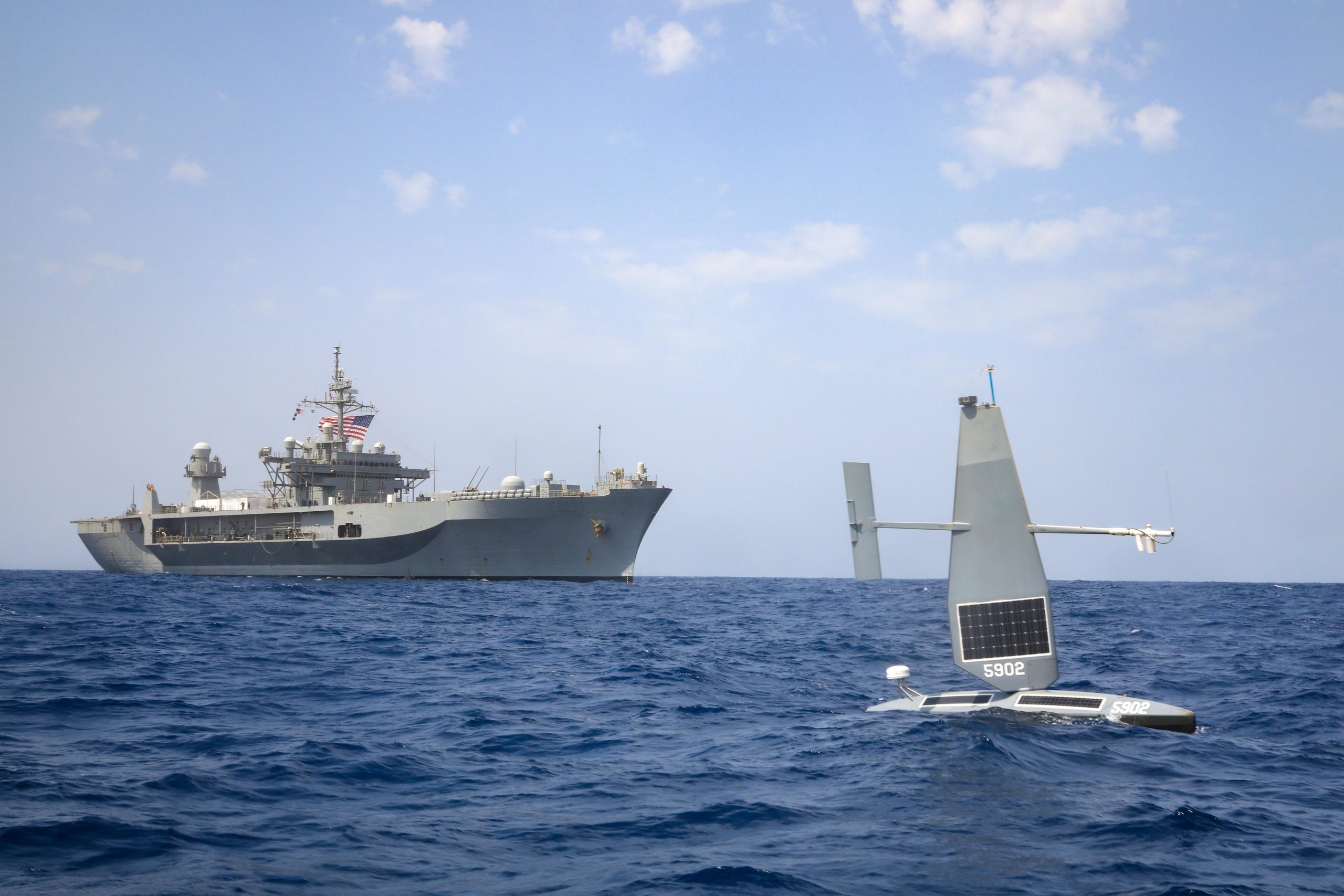
Lockheed Martin and Saildrone successfully launched two AGM-179 Joint Air-to-Ground Missiles (JAGM) from a 20-meter Surveyor-class unmanned surface vessel (USV) during the RIMPAC 2026 exercise near Hawaii. Announced on August 20, 2026, the trial demonstrated that a long-endurance autonomous platform can receive off-board targeting data from external force assets and execute a remote kinetic engagement.
Operating alongside the USS Theodore Roosevelt Carrier Strike Group, the Surveyor received target tracks generated by other naval units and passed them through the US Navy’s Adjunct Remote Engagement System (ARES) fire control setup. The platform engaged a surrogate high-speed surface craft using a dual-mode seeker that combines semi-active laser guidance and millimeter-wave radar, allowing target engagement without requiring the USV to handle the complete tracking chain independently, as reported on the official Lockheed Martin website.
The Surveyor relies on a combination of an 80 hp diesel engine and an auxiliary wing-sail system, offering a mapping cruise speed of 6 knots and an endurance of up to 100 days between maintenance intervals. Designed to supply up to 6 kW of peak payload power, the platform functions primarily as a long-range surveillance and pre-positioned firing node capable of operating thousands of nautical miles from its base.
While the JAGM’s range of approximately 8 kilometers remains limited for naval combat, the test validated networked target sharing to relieve crewed combatants from managing routine surface threats. Development plans call for transitioning the system to the larger 52-meter Spectre-class USV, which operates at speeds up to 27 knots and can carry containerized systems such as the Mk 70 launcher, opening the possibility to deploy heavier Standard or Tomahawk missile families on unmanned hulls.