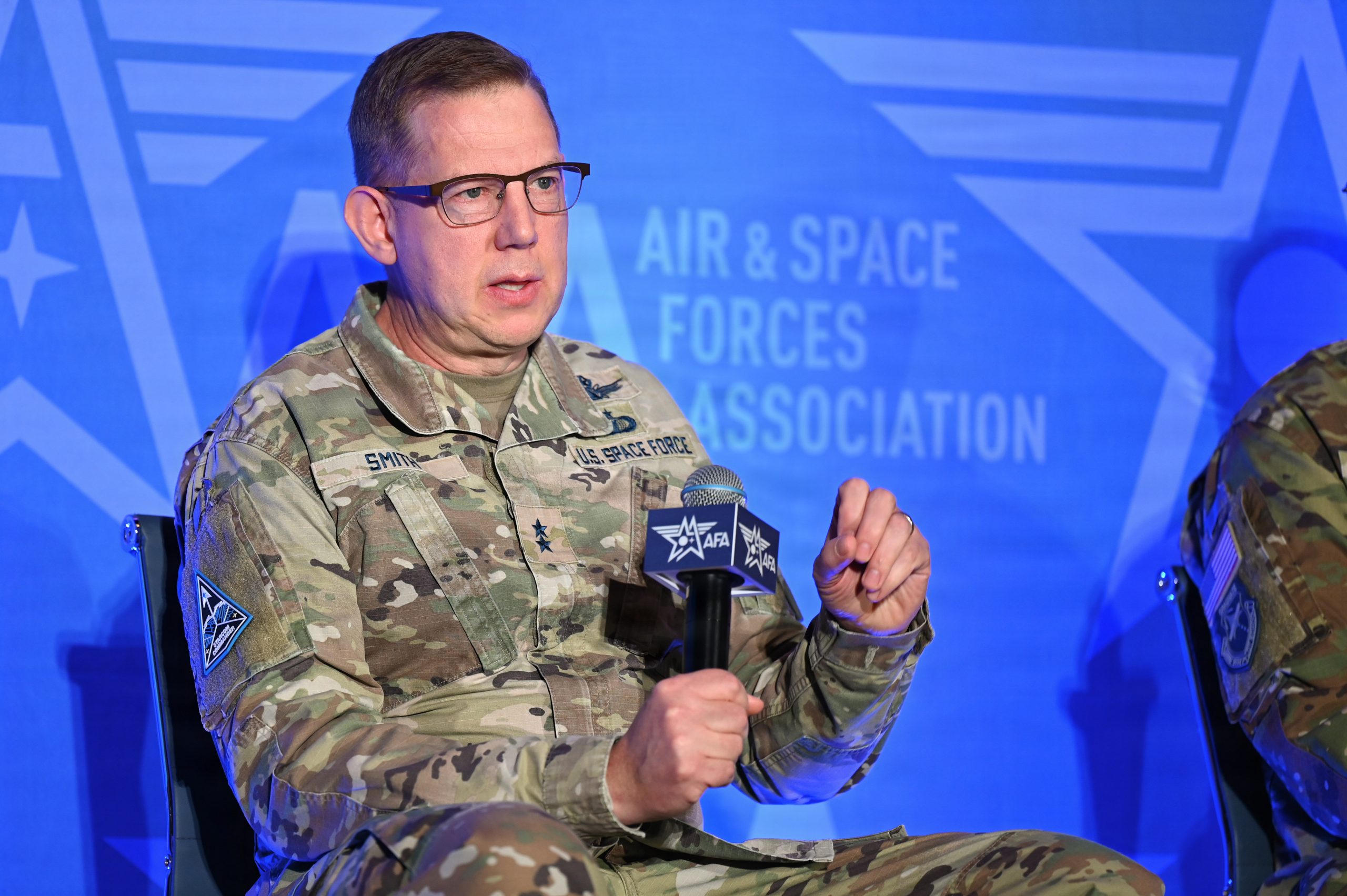
Remarks by Maj. Gen. James E. Smith during a media roundtable and the Growth of the Space Force panel at the Air and Space Forces Association’s 2026 Air, Space and Cyber Conference in National Harbor, Maryland.
With the Space Force set to double its uniformed ranks over the next five years, Smith laid out how STARCOM plans to turn that expansion into a combat-ready force rather than just a larger one. “We understand the requirements behind right-sizing the Space Force, and we are fully postured to meet those goals for FY27,” he said. “Adding 10,000 Guardians over the next five years represents our target, with a significant portion of that growth occurring in the first year. Predictable budget resources will remain vital as we scale operations to maintain our FY27 momentum.”
Reaching that number, Smith said, depends less on recruiting pipelines than on convincing experienced Guardians to step into the classroom. STARCOM is currently seeking more than 200 Guardians and civilian specialists to fill instructor roles spanning officer and enlisted training, from Air Force ROTC detachments and Officer Training School at Maxwell Air Force Base to the U.S. Air Force Academy and enlisted schoolhouses. “Our success hinges entirely on our people, and recruiting top talent into instructor billets creates the combat credibility our service needs,” he said. “STARCOM is the crucible where Guardians are shaped and systems are proven.”
The scale of the buildup shows up most clearly in STARCOM’s own training numbers for fiscal 2027. Basic Military Training is set to expand by more than 90 percent to accommodate over 1,400 recruits. Officer Training School will scale nearly 600 percent to prepare roughly 850 trainees, while ROTC commissions are expected to double to around 300. The follow-on Officer Training Course will grow roughly 275 percent to more than 1,350 officers, and officer professional military education will absorb an additional 1,600 students — a 330 percent jump.
Smith framed the push for Guardian-specific training as inseparable from that growth, drawing a comparison to how the Marine Corps trains differently from the Navy despite sharing a department. “While we currently have a great partnership with the US Air Force for many of our development courses,” he said, “ultimately, Guardians require space-minded education and rigorous, domain-specific training to ensure combat credibility, integrate seamlessly with the joint force and protect national interests.” He pointed to STARCOM’s Captains Leadership Course, run with Texas A&M University since January, as a model for that approach — the program has graduated more than 270 Guardians, and the Space Force recently signed a 10-year agreement extending the partnership through 2036.
Smith closed by tying the training pipeline directly to the stakes of the mission it feeds. “Every American relies daily on space-enabled capabilities, which means our joint and coalition forces must possess the ability to operate in, from, and to space at a time and place of their choosing,” he said.
Source: DVIDS