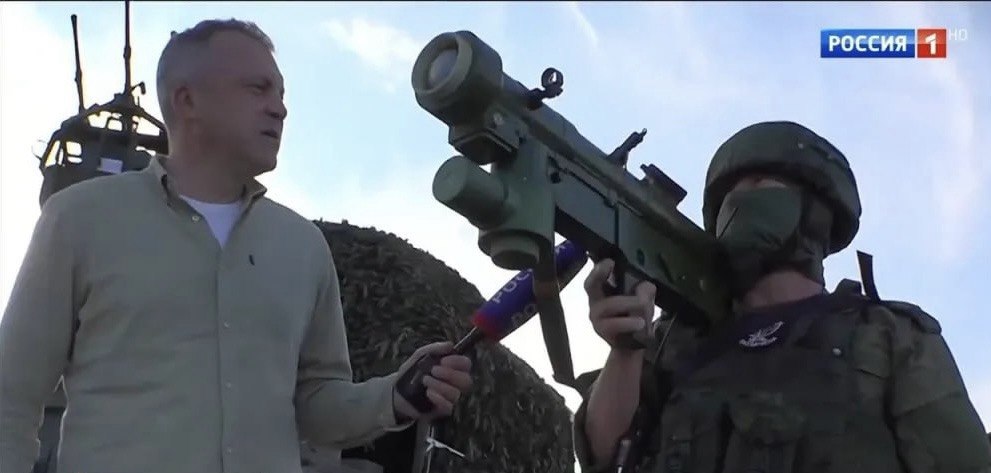
An unusual man-portable surface-to-air missile system has been spotted in Russia. It does not resemble the known Russian MANPADS families. Its exact origin and model have not yet been established.
The weapon appeared in television footage from the Rostov region, showing a mobile air defense group during an exercise. According to The War Zone, one of the units of Russia’s 51st Air Defense Division took part in the exercise.
Russian personnel seen in the footage reportedly referred to the system as “Iva.” However, this designation alone does not confirm either the model or the origin of the weapon.
Based on its appearance, the new MANPADS has been compared with the Iranian Misagh-3 and Chinese QW-series systems, including the QW-18, QW-18A and QW-19. Particular attention has been drawn to a box-like component at the front of the launcher. According to The War Zone’s assessment, this feature is more consistent with Chinese QW systems than with the Misagh.
At the same time, an Iranian origin has not been completely ruled out because of the limited number of publicly available images of later Misagh variants. Another possibility is that the system could be a Russian version or derivative of a Chinese or Iranian design.
Other possibilities include an imported system, a weapon acquired for evaluation, a captured system, or a previously unidentified Russian configuration. The War Zone also mentions a possible North Korean origin, while noting that there is no known North Korean MANPADS matching the configuration seen in the footage.
The publication also highlights a Reuters report from July 2026 about an expected delivery to Iran of 300–400 Chinese-made MANPADS, including the QW-12 and FN-16. However, there is currently no evidence linking the system seen in Russia to this procurement.
The exact model and origin of the MANPADS remain unconfirmed. Further images or additional appearances of the system in Russian service could help determine what the weapon is and where it came from.