South Korea has awarded its first mass-production contract for a multipurpose military robot to Hanwha Aerospace, but the underlying driver of the decision has less to do with pursuing cutting-edge robotics than with addressing a shrinking pool of young men available for military service.
As reported by Defence Blog, citing GlobalData, South Korea’s Defense Acquisition Program Administration selected Hanwha’s Arion-SMET unmanned ground vehicle (UGV) in July 2026. The platform is scheduled to enter service between 2027 and 2028 as a core element of the Army Tiger 4.0 initiative, the military’s ongoing effort to digitize and network its ground forces through artificial intelligence, unmanned systems, and networked combat capabilities.
The Defense Acquisition Program Administration notified Hanwha of its selection for the 49.6 billion won ($33.6 million) program, which the company secured after competing against Hyundai Rotem. The arms procurement agency’s defense project management committee previously reviewed and approved the platform for the national program. Hanwha plans to sign the mass-production contract with the procurement agency as early as August.
According to Defence Blog’s reporting on GlobalData’s analysis, the country’s active-duty military personnel numbers fell from approximately 560,000 in 2019 to around 450,000 in 2025. This decline is directly tied to an ongoing demographic crisis, as plummeting birth rates continue to reduce the number of young men eligible for mandatory conscription. GlobalData views the Arion-SMET procurement as a direct operational response to this manpower deficit rather than an attempt to surpass rival militaries in technological capability.
GlobalData projects South Korea will invest roughly $140 million in UGV acquisitions through 2036. The platforms will handle logistics transport, intelligence and reconnaissance, explosive ordnance disposal, and mine clearance—tasks that previously required personnel to haul heavy equipment or navigate hazardous environments on foot.
Highlighting the demographic pressure, data from the Korea Institute for Defense Analyses indicates that the pool of fit conscripts dropped by 29% over the past decade and could hit 100,000 by 2038. Analysts note that substituting machines for personnel at squad level is driven by pure arithmetic rather than tactical doctrine.
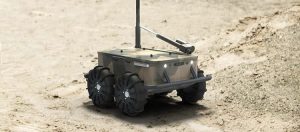
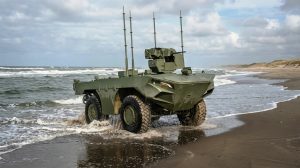
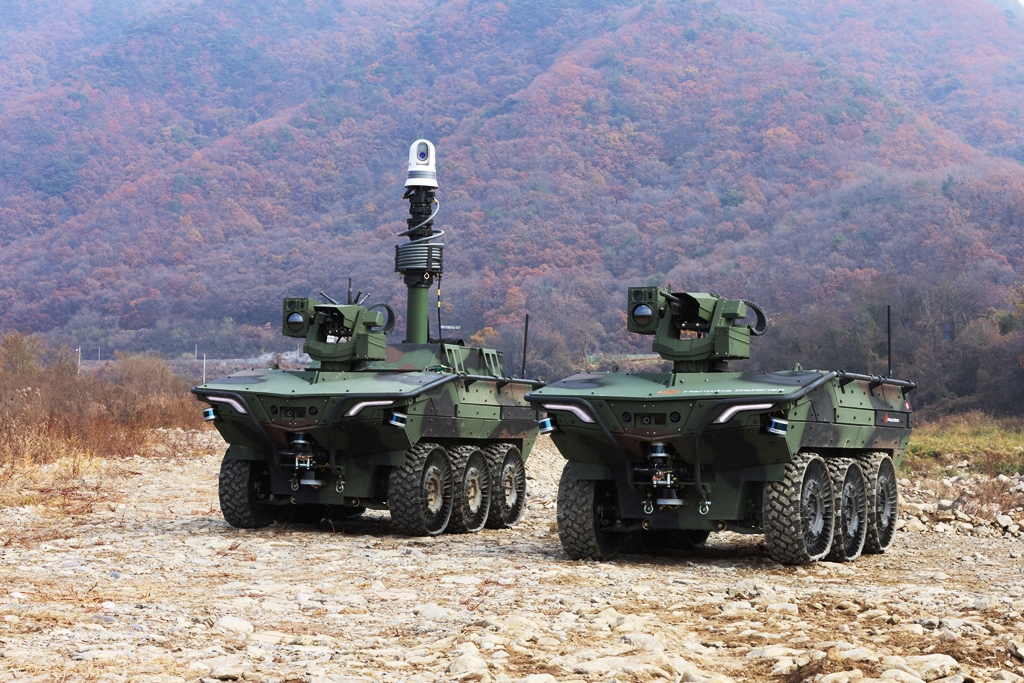
The Arion-SMET (Autonomous and Robotic systems for Intelligence Off-road Navigation, Small Multi-purpose Equipment Transport) is a 2-ton, six-wheeled, fully electric vehicle. It can carry a payload of about 990 pounds (up to 550 kilograms in maximum capacity configuration) and operate for up to 100 kilometers (62 miles) on a single charge. The vehicle reaches speeds of 43 km/h (27 mph) on paved roads and 22 km/h (14 mph) off-road. It is equipped with day-and-night surveillance systems that help distinguish friendly forces from potential threats and is designed for extended continuous operations. Its features include remote-controlled driving, autonomous off-road navigation, and a soldier-following mode. While the platform can host a remote-controlled weapon station capable of automatically detecting and returning fire, South Korea’s initial mass-production order focuses exclusively on its unarmed logistics and support roles.
Before securing the domestic contract, the Arion-SMET underwent evaluations by foreign forces. In late 2023, it became the first South Korean-developed UGV to complete the U.S. Department of Defense’s Foreign Comparative Testing program. The U.S. Marine Corps and U.S. Army tested the vehicle in Hawaii, evaluating its performance in transporting fuel, food, and water, as well as conducting simulated casualty evacuations. These evaluations integrate the Korean UGV into the U.S. assessment pipeline, supporting future interoperability alongside allied forces on the peninsula.
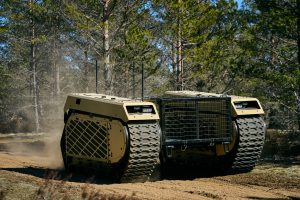
Building on that momentum, Hanwha partnered earlier this year with Estonian robotics developer Milrem Robotics—creator of the THeMIS platform—to jointly target Romania’s UGV procurement program by combining wheeled and tracked platform technologies.
Hanwha Aerospace is also involved in projects to develop and deploy unmanned reconnaissance vehicles, explosive ordnance detection and disposal robots, and manned-unmanned chemical, biological, and radiological reconnaissance vehicles. “As South Korea’s leading UGV platform company, we will continue building a comprehensive manned-unmanned teaming portfolio that combines unmanned systems with existing platforms such as the K9 self-propelled howitzer and infantry fighting vehicles,” a Hanwha Aerospace official said, adding that the company would rapidly begin mass-production procedures to minimize any gap in military capabilities.
Holding contracts across almost all major South Korean UGV lines allows Hanwha to build the production volume needed to lower unit costs before global market competition intensifies. Furthermore, while Seoul has not yet committed to a dedicated combat UGV, using a multipurpose platform that can accommodate a remote weapon station leaves that operational route available for future expansion.
According to GlobalData, the Arion-SMET contract represents nearly a quarter of South Korea’s total planned UGV expenditure through 2036. As low birth rates continue to impact militaries worldwide, South Korea’s shift toward automated support platforms may serve as a model for other nations facing similar demographic constraints.