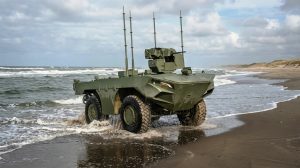
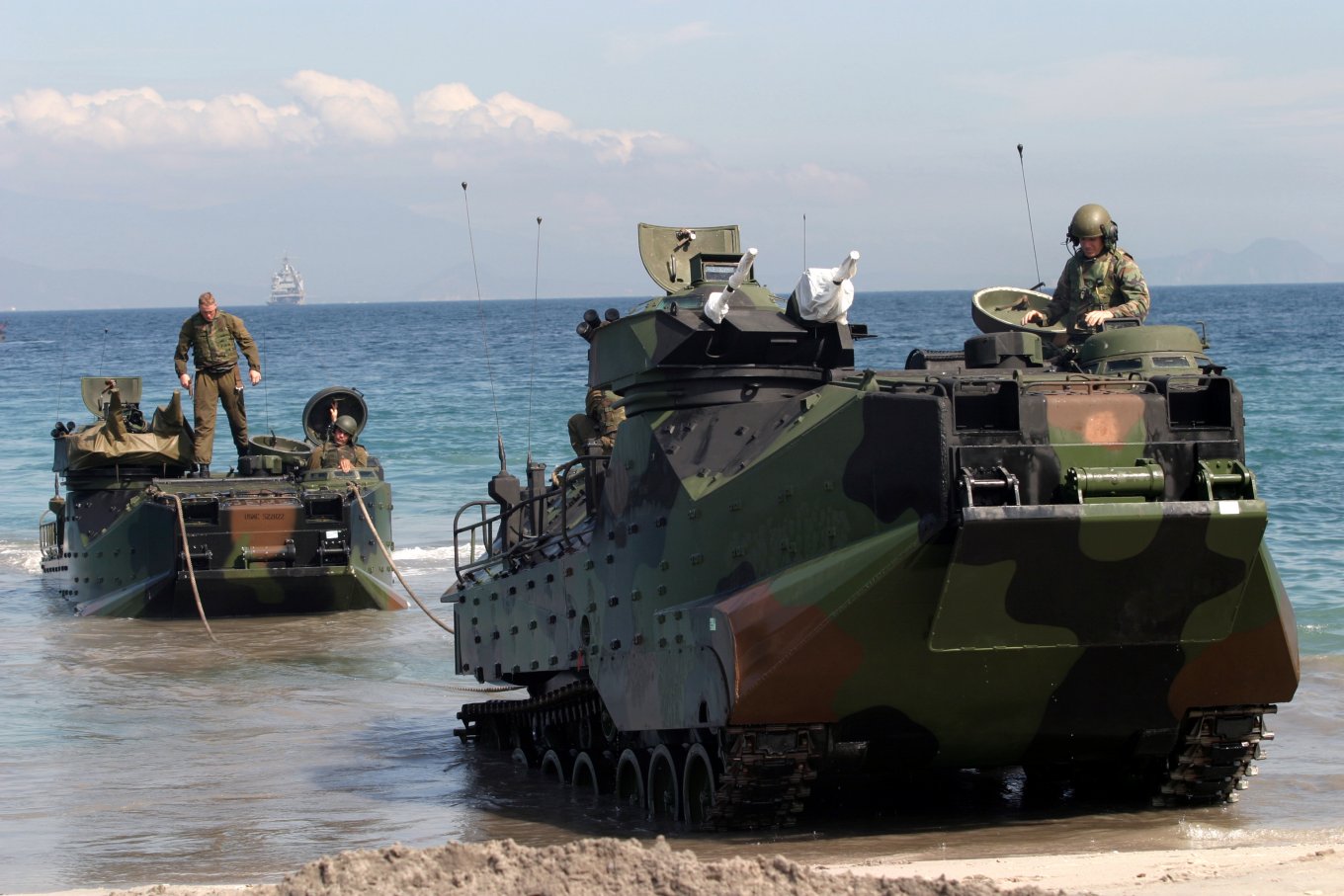
An amphibious vehicle of the U.S. Marine Corps capable of swimming ashore from a warship still faces a modern vulnerability: it cannot prevent a commercially available drone from tracking its every movement. However, the Marine Corps has officially identified a solution and the contractor intended to deliver it—without opening the contract to public competition.
On August 3, 2026, the Marine Corps’ Program Manager Advanced Amphibious Assault released a Notice of Intent to Sole Source and Sources Sought, confirming plans to negotiate directly with California-based defense tech firm Anduril Industries. The procurement aims to equip the Amphibious Combat Vehicle (ACV) fleet with Anduril’s Pulsar Lite MKI-RX/TX 4CH system (Pulsar-L), complete with control interfaces, omnidirectional antenna arrays, electronic warfare software, and ongoing technical support.
Built by BAE Systems to replace the aging Assault Amphibious Vehicle, the ACV is an 8×8 wheeled armored platform designed to launch from offshore ships, navigate rough surf, and transport 13 combat-ready Marines alongside a three-person crew inland. While the platform reached full production across multiple variants after achieving initial operational capability in 2020, guidance from the Marine Corps Capabilities Development Directorate indicates the current fleet entirely lacks integrated systems to detect, track, identify, or defeat small unmanned aerial systems.
Citing an Urgent Statement of Need, officials emphasized that the operational gap is too time-sensitive for traditional, multiyear acquisition timelines. According to guidance quoted in the notice, official planning documents identify the Anduril Pulsar-L as the only immediate, viable capability on the market. This decision aligns with precedent set earlier in March 2026, when the U.S. Army integrated Pulsar-L systems into its own combat vehicle fleets under a similar sole-source agreement.
The operational parameters set by the Marines demand an onboard electronic warfare package capable of detecting GPS- or RF-dependent drones at distances between 2 and 5 kilometers (1.2 to 3.1 miles), with effective jamming out to 2 kilometers (1.2 miles). The system must operate dynamically while the ACV is parked or moving, engage multiple threats simultaneously, adapt to emerging threat tactics without relying on static threat libraries, and withstand harsh maritime and land environments.
While officials have not disclosed the exact space and weight limits, the long-term target requirement mandates a single integrated module weighing no more than 35 pounds (15.9 kg). This future variant will extend jamming ranges beyond 2 kilometers, incorporate targeted GPS defeat mechanisms, and interface directly with existing internal ACV crew displays.
To meet the Marine Corps’ deployment timeline starting in the first quarter of Fiscal Year 2027, the selected vendor must demonstrate the capacity to produce over 50 counter-drone units within 12 months. Competing firms have until August 18, 2026, to submit executive capability statements, though the document explicitly signals that the Marines have effectively selected Anduril barring an unforeseen alternative.
This move further solidifies Anduril’s expanding presence across Allied defense infrastructures, following a $20 billion enterprise contract with the U.S. Army in March 2026 and a $1.98 billion foreign military sale to Kuwait in June 2026. For the Marine Corps, leveraging established architecture presents a clear path to closing a critical survivability gap at operational speed.