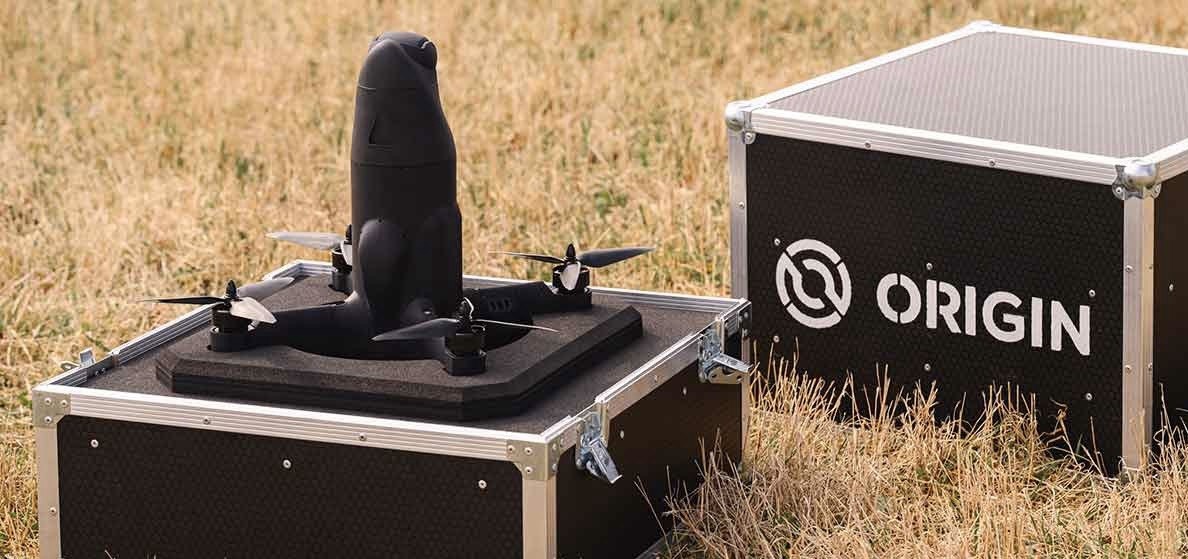
Latvian defense technology company Origin and Poland’s Military Institute of Armament Technology, known as WITU, have introduced the Blaze autonomous counter-drone interceptor featuring a newly integrated directional fragmentation warhead at the MSPO exhibition in Kielce.
The warhead was engineered specifically for Blaze to meet modern counter-drone operational requirements, combining a focused blast effect against aerial targets with multiple mechanical, electronic, and software-controlled safety layers. The module holds a NATO stock number, making Blaze the first NATO-codified interceptor drone equipped with a Standardization Agreement-compliant warhead module, according to Soldier Systems Daily.
The compact high-explosive fragmentation module weighs 700 grams and projects a concentrated pattern of high-velocity steel fragments toward targets while maintaining the agility of the interceptor. WITU developed the Electronic Safe and Arm Device to govern activation, integrating the explosive charge, fragmentation package, electronically controlled fuze, and mechanical safety mechanisms into a single precision-engineered unit. The system remains disarmed until specific flight parameters are satisfied, can be armed and disarmed repeatedly during flight, and automatically resets to a safe status if an engagement is aborted, allowing the drone to return and land safely.
Col. Piotr Ruliński, Head of the Center for Ballistics and Unmanned Systems at WITU, noted that the safety and standardization requirements applied to the Blaze system mirror those utilized for the Polish armed forces. Origin is scaling up manufacturing through partnerships with electronics producers across Europe to accommodate increasing demand from NATO member states. The Blaze interceptor is on display at the WITU exhibition stand at MSPO in Kielce, Poland, running from September 8 to 11, 2026.