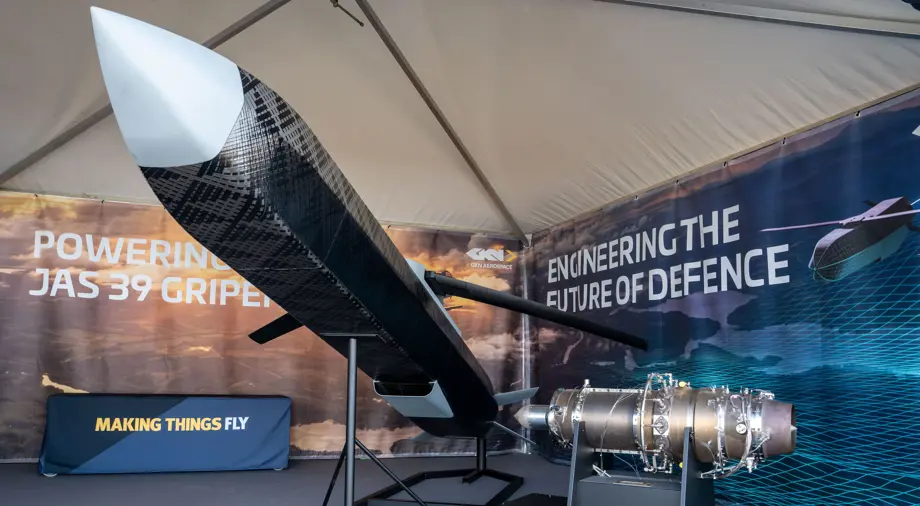
GKN Aerospace has developed a compact turbojet engine and an accompanying uncrewed aerial vehicle demonstrator under Project Otto, an initiative launched by the Swedish Ministry of Defense to establish a long-range strike capability. Unveiled at Malmen Air Base in Linköping, the system was engineered in under a year despite an initial 18-month timetable. While designated as a drone demonstrator, its operational parameters align closely with long-range cruise missiles and one-way attack platforms.
The engine relies heavily on additive manufacturing to streamline component production, shorten lead times, and facilitate future scaling. Crucially, the propulsion system contains no U.S. components, rendering it free from International Traffic in Arms Regulations (ITAR) and export constraints. Funded through a 150 million Swedish kronor (approximately $15.8 million) defense contract, the project combines GKN Aerospace’s European assets, integrating propulsion expertise from Sweden’s Volvo Aero and airframe engineering from the Netherlands’ Fokker, as reported in a press release by GKN Aerospace.
The demonstrator is designed to carry payloads between 100 and 300 kilograms over ranges from 600 to 1,000 kilometers. According to Swedish Brigadier General Carl-Fredrik Edström, the platform’s initial test flight is scheduled for early 2027 at the latest.
Beyond Swedish defense requirements, the compact engine presents potential relevance for Ukrainian long-range strike initiatives, which require scalable, cost-effective small turbojets. The platform’s payload-to-range profile, combined with an ITAR-free architecture, could simplify technology transfers or licensing arrangements, offering a potential path for joint defense-industrial production.